2026 Best Rotary Positioners for Global Buyers

Choosing the right rotary positioner in 2026 requires more than comparing rotation speed and advertised load capacity. Global buyers must examine welding quality, control accuracy, safety design, service access, and long-term operating costs. A positioner that performs well in a factory demonstration may struggle with uneven workpieces, frequent indexing, or dusty production floors.

This guide evaluates leading rotary positioners through practical buying criteria. It considers payload ratings, table diameter, tilting range, rotation control, repeatability, and compatibility with welding automation. Real-world details matter. A 500-kilogram assembly may behave differently when its center of gravity sits far from the table. Cable routing, emergency stops, foot-pedal controls, and replacement parts also deserve close attention. Small details often decide production stability.

Performance claims need careful review. Not every “heavy-duty” model offers the same duty cycle or positioning accuracy. Buyers should request test data, installation guidance, warranty terms, and regional technical support before placing an order. Local voltage requirements and operator training can affect the final cost. These issues are easy to overlook.

The best choice depends on the application, not the brochure. A compact workshop may value flexibility, while a large fabrication plant may prioritize integration and repeatable cycle times. This comparison aims to provide a clear, evidence-based starting point for global purchasing decisions. Some rankings may remain debatable. That is normal. Equipment selection should include site trials, supplier verification, and honest evaluation of future production changes.
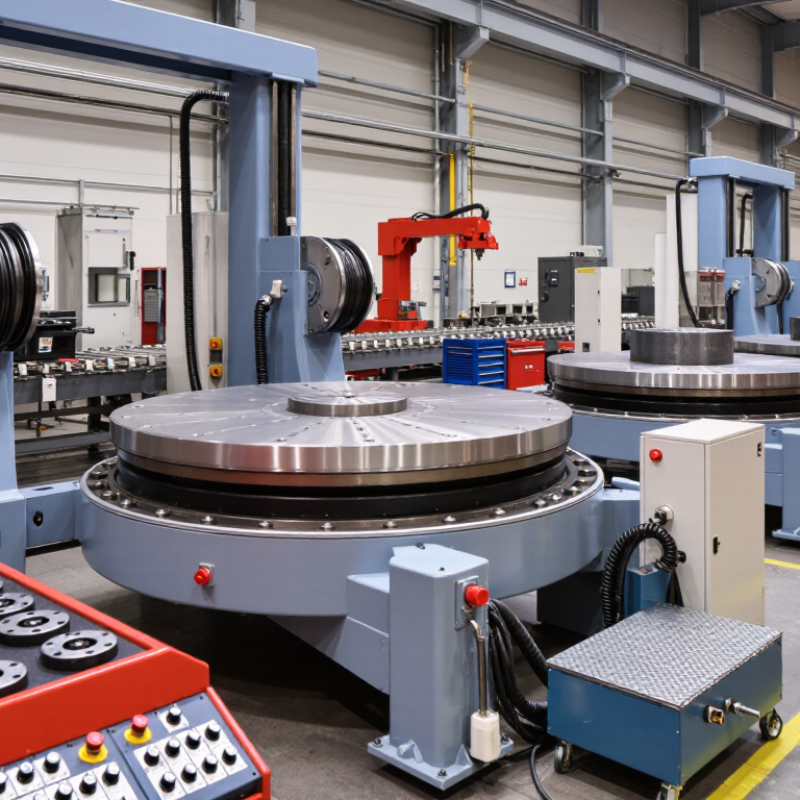
2026 Best Rotary Positioners for Global Buyers

Define Rotary Positioner Classes by 100–10,000 kg Payload and 0.1–10 rpm

For global buyers, rotary positioners in 2026 should be classified by payload and controlled speed, not appearance. A practical framework covers four payload bands: 100–500 kg, 500–2,000 kg, 2,000–5,000 kg, and 5,000–10,000 kg. The speed range is equally important. Units running at 0.1–1 rpm suit large weldments and high-torque indexing. Systems operating at 1–3 rpm fit general fabrication. Speeds from 3–10 rpm support lighter, repetitive work.

The payload is not the whole story. A 1,000 kg frame with an offset center can create more overturning torque than a compact 3,000 kg load. Buyers should check rated moment, allowable inertia, table diameter, braking performance, and repeatability. ISO 9283 provides useful methods for evaluating positioning performance, although it was written mainly for industrial robots. ISO 12100 and ISO 13849-1 also guide risk reduction and control-system safety. Real workshop evidence matters: measure acceleration, stopping distance, and vibration with the actual fixture installed.

Demand for automated handling remains strong. The International Federation of Robotics reported 541,302 industrial robot installations worldwide in 2023 in World Robotics 2024. This growth increases the need for compatible positioners. Still, a neat four-class chart is only a starting point. It may fail when long pipes, liquid-filled vessels, or uneven fixtures shift the load. Buyers should request test data at the intended payload, rpm, duty cycle, and eccentricity—not only a headline capacity.

2026 Best Rotary Positioners for Global Buyers - Define Rotary Positioner Classes by 100–10,000 kg Payload and 0.1–10 rpm

Reference classification for industrial welding, fabrication, assembly, and material-handling applications. Actual capacity depends on center of gravity, eccentric load, speed, duty cycle, and fixture design.

Positioner Class Rated Payload Typical Speed Range Recommended Table Diameter Typical Tilt Range Typical Application Drive and Control Selection Considerations
Class R-100 100 kg 0.1–10 rpm 400–600 mm 0–90° manual or powered Small weldments, pipe fittings, light fabrication, inspection Geared AC motor or servo motor; foot pedal and basic speed controller Confirm fixture weight and offset load; suitable for low-to-medium duty cycles
Class R-250 250 kg 0.1–8 rpm 500–800 mm 0–90° powered Medium brackets, flanges, frames, and general welding fixtures Worm-geared drive or servo drive; variable-speed pendant control Check table flatness, mounting-hole pattern, and emergency-stop integration
Class R-500 500 kg 0.1–6 rpm 700–1,000 mm 0–135° powered Pressure-vessel components, structural frames, and automated welding cells AC geared motor or servo motor; programmable speed and position control Allow for fixture mass, weld cable routing, and continuous-duty heat dissipation
Class R-1,000 1,000 kg 0.1–5 rpm 900–1,400 mm 0–135° powered Large frames, tanks, vehicle components, and robotic welding fixtures Heavy-duty gearbox with inverter or servo control; encoder feedback optional Foundation stiffness and overturning moment are critical for off-center loads
Class R-3,000 3,000 kg 0.1–3 rpm 1,200–1,800 mm 0–135° or 0–180° powered Heavy weldments, construction machinery parts, and large cylindrical assemblies Industrial gearbox and brake motor; PLC, pendant, and robot-interface options Verify static and dynamic torque, bearing life, braking capacity, and anchoring
Class R-5,000 5,000 kg 0.1–2 rpm 1,500–2,200 mm 0–135° powered Large tanks, industrial machinery, steel structures, and heavy-duty welding Low-speed high-torque gearbox; closed-loop speed and position feedback Use engineered load analysis for eccentricity, inertia, weld impact, and stopping torque
Class R-10,000 10,000 kg 0.1–1 rpm 2,000–3,000 mm 0–90° or 0–135° powered Large pressure vessels, heavy transport equipment, and oversized fabrication Multi-stage industrial gearbox; PLC, safety circuit, encoder, and automation integration Require site-specific engineering for foundation, lifting, guarding, braking, and maintenance access
Buyer checklist: Specify payload including the fixture, center-of-gravity offset, required rotation speed, tilt angle, duty cycle, table diameter, mounting pattern, power supply, control interface, safety requirements, and installation environment before selecting a rotary positioner.

Compare Tilt, Rotation, and Torque Ratings Using ISO 9283 Accuracy Tests

For global buyers, rotary positioner comparisons should begin with measured behavior, not catalog promises. Tilt range, rotation speed, and torque ratings describe capability, but they do not prove accuracy. ISO 9283 mainly addresses industrial robot performance. Its test methods can be adapted to rotary positioners under controlled payloads and repeatable conditions. That distinction matters.

Measure commanded and achieved angles at several positions, such as 0°, 90°, 180°, and 270°. Repeat each movement in both directions. This exposes positioning error, backlash, and uneven rotation. Use a calibrated encoder or an external measurement system. Record results after warm-up, because thermal drift can change readings. Small errors become visible.

Torque needs equal attention. Static holding torque is not the same as dynamic torque during acceleration. A positioner rated for 500 Nm may perform differently with an offset load, frequent reversals, or a tilted fixture. Compare the load center, duty cycle, acceleration, and safety margin. Read the duty cycle.

No test is perfect. Fixture stiffness, sensor alignment, and operator setup can distort results. An ISO-style accuracy report improves confidence, but it cannot replace a realistic production trial. A practical evaluation should include a warm metal fixture, repeated stops, and a full working payload. Sometimes the most impressive rating fails under heat. That finding is inconvenient, but useful.

2026 Best Rotary Positioners for Global Buyers

Comparison of tilt range, continuous rotation speed, rated torque, and bidirectional positioning accuracy evaluated with an ISO 9283-style test approach.

The four categories represent common industrial positioner classes rather than individual manufacturers. Torque, tilt, and speed values are representative specification levels used in global equipment selection. Lower ISO 9283-style angular positioning error indicates better accuracy. Actual results depend on payload, mounting orientation, calibration, temperature, and test configuration.

Match Welding Applications to AWS D1.1 Standards and Duty-Cycle Data

2026 Best Rotary Positioners for Global Buyers

A rotary positioner should support the welding procedure, not simply turn a workpiece. Under AWS D1.1, the welding procedure, welder qualification, inspection, and acceptance criteria remain central. The positioner helps maintain the intended welding position and travel consistency. It does not replace procedure qualification.

Match the machine to the joint first. A fillet weld on a compact frame may need steady rotation near 2 rpm. A large beam can demand higher torque, wider chuck capacity, and controlled acceleration. Check rated load, eccentric load, tilt angle, and fixture weight together. A 1,000-kilogram rating may fall sharply when the load sits far from the table center.

Duty-cycle data deserves careful reading. Some suppliers calculate it over ten minutes, while others use a different test method. Ask for the reference period, ambient temperature, rotation speed, and allowable load. For example, 60% duty cycle may mean six minutes of operation and four minutes of rest within one cycle. That figure may change with continuous rotation, frequent starts, or heavy off-center loads.

Keep records from real production. Measure motor temperature, stopping accuracy, and cycle time during a full shift. Small errors become visible on long seams. I have seen a positioner pass a short workshop test but struggle after repeated indexing. That result is worth questioning. Buyers should compare measured performance with the AWS D1.1 procedure requirements, not rely on brochure ratings alone.

Rank 2026 Models by ±0.1° Repeatability, Controls, and 360° Rotation

2026 Best Rotary Positioners for Global Buyers

The 2026 ranking should begin with ±0.1° repeatability, not payload alone. ISO 9283 testing provides a stronger basis for comparing positioning accuracy across different machines. A high-ranking model should repeat movements within ±0.1° after warm-up, under its rated load, and through a full 360° rotation.

The precision class leads for welding, inspection, and camera indexing. It needs low backlash, encoder feedback, and stable speed control. The balanced class follows closely, combining ±0.1° repeatability with programmable acceleration and common industrial communication.

A third heavy-duty class may carry larger fixtures, but it should not win if accuracy shifts near maximum payload. That detail is often missed.

Controls matter during real production. Look for teach pendants, stored recipes, remote diagnostics, and smooth integration with PLC systems. The International Federation of Robotics reported 541,302 industrial robot installations in 2023, showing why reliable peripheral equipment matters across expanding automation lines. Still, market growth does not prove every positioner is dependable. A ranking can mislead.

Buyers should record five cycles, measure angular error, and check repeatability after several hours. Test it cold, too. Safety interlocks, emergency stops, and overload protection deserve equal attention. A compact unit with clearer controls may outperform a stronger machine with confusing software. Manufacturers’ published ±0.1° figures also need independent verification before procurement.

Evaluate Global Compliance Through CE, UL, IEC 60529, Warranty, and TCO

Global rotary positioner buyers need more than repeatability figures. The International Federation of Robotics reported 541,302 industrial robot installations in 2023, a 10% annual increase. This growth raises procurement pressure, but compliance still requires careful verification. CE marking indicates conformity with applicable European requirements; it is not an independent performance grade. Check the Declaration of Conformity, technical file references, and machine integration limits.

For North American projects, UL certification can simplify safety reviews and site acceptance. IEC 60529 defines IP test methods, but an IP rating does not guarantee resistance to oil, abrasion, or long-term condensation. Ask for test conditions, enclosure materials, cable-entry details, and evidence from comparable environments. Small omissions matter. A sealed connector may still fail after repeated rotation.

Warranty terms deserve the same scrutiny as certificates. Compare coverage duration, excluded wear parts, response time, replacement shipping, and calibration support. The U.S. Department of Energy’s operations and maintenance guidance treats preventive maintenance as a lifecycle cost control, not merely a repair expense. Calculate total cost of ownership from purchase price, installation, energy use, downtime, spare parts, service travel, and disposal. I would not trust a long warranty alone. It may hide slow claims handling or costly return logistics. The weak point is often integration, not the positioner itself.

Contact Us