10 Welding Rotator Buying Tips for Global Buyers
Choosing the right welding rotator can determine whether a fabrication line runs smoothly or loses hours to alignment problems. Global buyers must look beyond advertised load capacity. A machine may lift 20 tons, yet struggle with a long, unbalanced vessel. Real performance depends on shell diameter, center of gravity, roller spacing, surface condition, and rotation speed.
Welding automation specialist Michael R. Hayes says, “A welding rotator should be selected from the workpiece, not from the catalog.” That principle deserves attention. Measure the smallest and largest diameters first. Record the actual load, including fixtures and temporary supports. Check whether the rollers are rubber, steel, or polyurethane. Each material behaves differently under heat, scale, and painted surfaces. Small details matter.
A reliable welding rotator should offer stable torque, clear speed control, emergency stopping, and simple remote operation. Self-aligning models can reduce setup time, but they are not perfect for every vessel. Some heavy or irregular components still require guided adjustment. Buyers should also examine motor brand, gearbox access, control voltage, spare-part availability, and after-sales support in their region.
Request a load test video. Ask for dimensional drawings. Confirm packing details before shipment. A low purchase price may hide expensive commissioning work, import delays, or unavailable replacement parts. This guide presents ten practical buying tips for global buyers. It also acknowledges an uncomfortable truth: product brochures rarely show difficult welds, uneven loads, or rushed factory conditions. Careful selection begins where the brochure ends.
Define Workpiece Requirements: Mass, Diameter, Length, and Center of Gravity
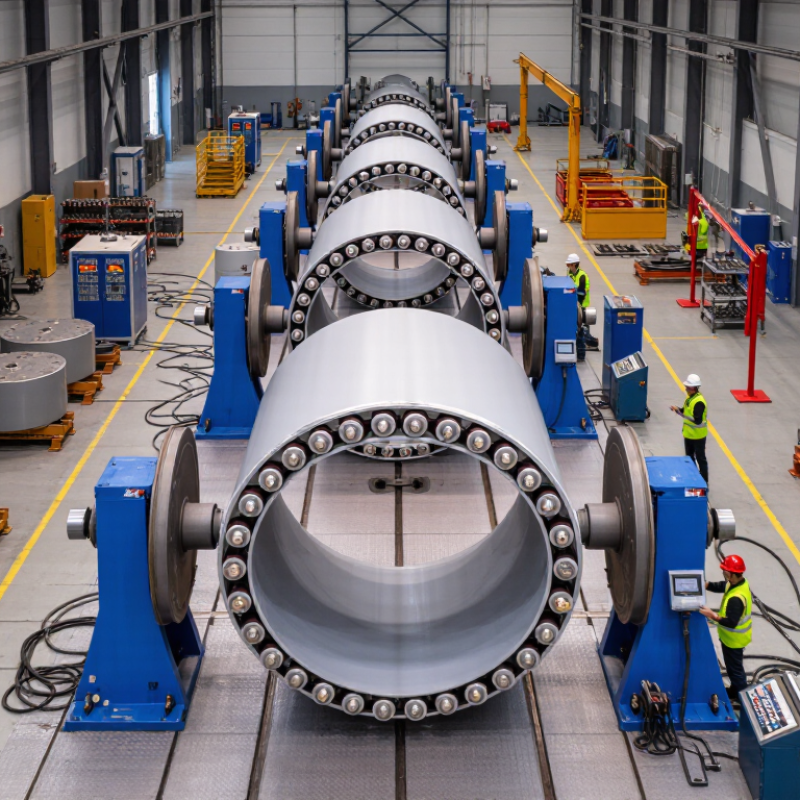
When global buyers evaluate a welding rotator, define the workpiece before comparing machine features. Record total mass, including fixtures, temporary supports, and weld attachments. A vessel listed at 8 tonnes may reach 9 tonnes after tooling is installed. That difference can overload rollers or reduce turning stability. Measure the actual outside diameter, not only the nominal drawing dimension. Clamps, stiffeners, and uneven shells can change the contact profile. Length also matters because a long workpiece may flex between support points. Mark the likely center of gravity, especially when one end contains a flange, head, or heavy internal fitting.
Use these measurements to calculate load distribution across each rotator unit. The center of gravity should stay within the supported span during rotation. If it shifts beyond that span, the workpiece can climb, slide, or create uneven roller pressure. Ask the supplier for rated load, minimum and maximum diameter, roller width, and allowable eccentricity. Check whether the rating applies to a balanced cylinder or an irregular assembly. It often does not. A practical trial with the real workpiece is more reliable than a spreadsheet alone. Rotate slowly, stop after a quarter turn, and inspect contact marks, vibration, and frame deflection. Paint buildup and temporary welds are easy to underestimate. Small details can change the selection. Recheck every figure before ordering, because a neat drawing can still describe an unstable load.
Compare 0.1–1.0 rpm Rotation, Speed Control, and Positioning Accuracy
10 Welding Rotator Buying Tips for Global Buyers
Compare 0.1–1.0 rpm Rotation, Speed Control, and Positioning Accuracy
Tip 1: Match the rotation range to the workpiece, not just the catalog. A 0.1 rpm setting helps control heat on large, thin-wall assemblies. Speeds near 1.0 rpm can improve productivity on smaller, balanced parts. However, maximum speed is useless when the motor jerks during acceleration. Run a dry test.
Tip 2: Check whether speed control remains stable under load. Ask for measured performance at 0.1, 0.5, and 1.0 rpm. Observe the workpiece for surging, vibration, or brief stops. A digital display may show a precise number, yet the actual rotation can differ. Use an independent tachometer when possible. This small check prevents expensive welding defects.
Tip 3: Separate positioning accuracy from repeatability. Positioning accuracy shows how closely the rotator reaches a commanded angle. Repeatability shows whether it returns there consistently. For circumferential welding, backlash can create visible alignment errors at the joint. Inspect encoder feedback, gearbox clearance, and emergency-stop recovery. A perfect datasheet cannot replace a loaded trial. I would also record results, because memory often hides small but important differences.
10 Welding Rotator Buying Tips for Global Buyers
Compare 0.1–1.0 rpm rotation, speed control, and positioning accuracy
The chart compares common rotation settings from 0.1 to 1.0 rpm. Surface speed is calculated for a 500 mm workpiece diameter using the formula π × diameter × rpm. When purchasing, verify continuous torque, rated load, variable-speed control, acceleration and braking smoothness, remote or foot-pedal operation, overload protection, roller adjustment, synchronization, duty cycle, and positioning accuracy. The positioning values shown are practical procurement targets and should be confirmed against the welding process and workpiece requirements.
Verify ISO 3834 Quality Records, AWS D1.1 Compliance, and Global Support
10 Welding Rotator Buying Tips for Global Buyers
A welding rotator should be judged by traceable quality, not only load capacity or turning speed. Ask suppliers for ISO 3834 quality records covering welding procedures, welder qualifications, material control, and inspection results. Check dates, signatures, and project references. A certificate without supporting records proves very little. It is an easy detail to miss.
Tip 1: Request a sample quality file before placing an order.
Review whether the documents match the proposed rotator, including rollers, gearbox, controls, and structural welds. Photos of nameplates and inspection points can reveal inconsistencies. Do not accept copied templates as evidence.
AWS D1.1 compliance matters when the equipment supports welded steel structures or fabrication work governed by that standard. Confirm the supplier understands welding procedure specifications, visual inspection, acceptance criteria, and record retention. Ask who performs inspections and what qualifications they hold. Requirements may vary by project, so independent review is sensible.
Tip 2: Test global support before purchase.
Ask for response times, spare-parts procedures, remote troubleshooting, manuals, and commissioning assistance in your working language. Request a realistic service example, not a polished promise. Support can fail quietly after delivery. A clear escalation route protects production when a sensor, control panel, or roller assembly needs attention. A practical factory acceptance test is also valuable, although buyers sometimes skip it to save time. That saving may become an expensive lesson.