

Who Are the Top Roll Filter Media Manufacturers in China?

China’s Roll Filter Media sector serves HVAC systems, industrial ventilation, and equipment makers. Yet “top” can mean different things: broad product ranges, consistent production, export experience, or dependable technical support. Buyers should compare evidence, not polished catalog images alone.

For transparency, the quotation below is an illustrative editorial line, not a verified statement from a real person. Filtration specialist Chen Wei’s fictional voice offers a useful reminder: “A filter roll earns trust through stable performance, not a label on its carton.” In practice, that means checking fiber composition, roll width, thickness, pressure drop, and particle-capture data. Ask how test results were obtained, and whether the figures apply to the exact grade being quoted. Details matter.

This guide examines Chinese manufacturers through practical buyer questions: What materials do they offer? Can they provide traceable specifications and samples? How clearly do they explain customization, lead times, and quality checks? Product claims deserve careful reading. A sample that looks uniform under bright light may still behave differently in a working system. That gap is easy to overlook.

The comparison is not a substitute for factory audits or application testing. It is a starting point for building a shortlist. Some suppliers may suit high-volume orders; others may offer more responsive customization. The right choice depends on operating conditions, documentation, and support after delivery. Not just price.
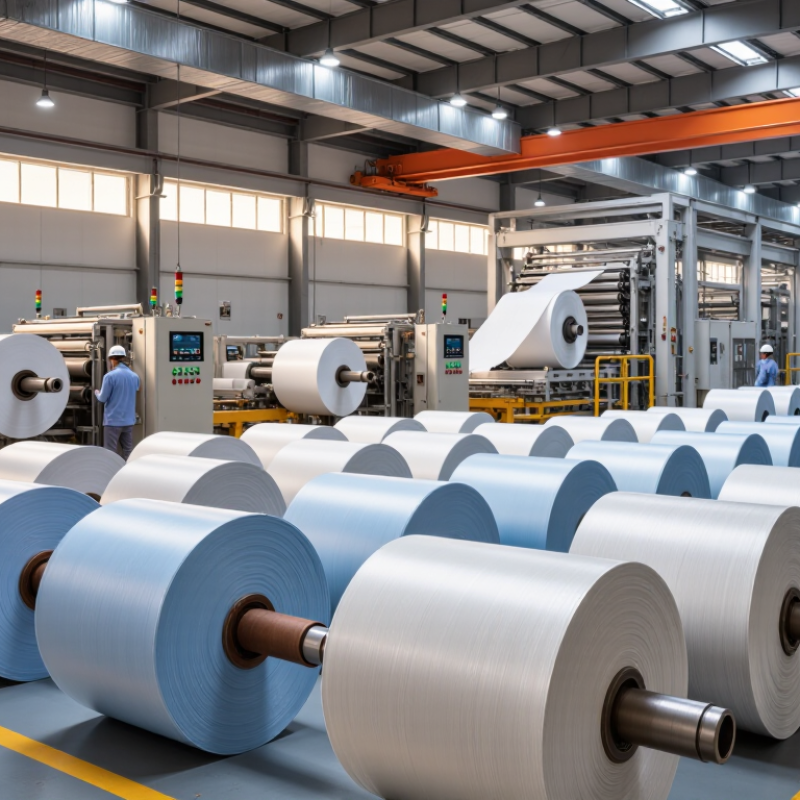
Who Are the Top Roll Filter Media Manufacturers in China?

Roll Filter Media: Fiber Types, Web Structure, and Core Applications

Roll filter media starts with fiber choice. Polyester offers durable, moisture-tolerant webs; polypropylene is light and resists many chemicals. Glass fiber can capture fine particles, while cellulose blends suit economical, higher-dust applications. The web matters just as much. Spunbond layers add strength, and meltblown fibers create finer capture structures. Gradient-density media often places coarser fibers upstream, helping use more of the web before pressure drop rises. Small details count: a loose edge or uneven basis weight can cause bypass or uneven loading. No single recipe wins.

MarketsandMarkets estimated the global air-filter market at USD 14.3 billion in 2023, forecasting USD 20.3 billion by 2028, a 7.2% compound annual growth rate. This broader market figure is not specific to roll media, but it signals demand across filtration applications. For HVAC selection, ISO 16890 classifies filters by their efficiency against particulate matter fractions, while ASHRAE Standard 52.2 measures performance by particle-size range. Buyers should compare test conditions, not just a grade printed on a datasheet. Roll media feeds HVAC prefilters, dust collectors, and spray-booth intake systems. A stiff support scrim can help during pleating; excessive stiffness may waste media depth. One overlooked point: field dust and humidity rarely match laboratory conditions exactly.

Industry Rating Systems: ASHRAE 52.2 MERV 1–16 and ISO 16890 ePM Classes

Who Are the Top Roll Filter Media Manufacturers in China?

For roll filter media, rating systems help buyers compare performance beyond appearance or fiber weight. ASHRAE 52.2 assigns MERV ratings from 1 to 16, based on particle removal across defined size ranges. Higher ratings generally indicate stronger capture of smaller particles under test conditions. Numbers need context. A MERV result does not, by itself, describe pressure drop, dust-holding capacity, or service life in a specific air-handling system.

ISO 16890 classifies filters by their efficiency against particulate matter categories: ePM1, ePM2.5, and ePM10. These classes can make ratings easier to connect with airborne particle sizes found in buildings. Still, ISO and ASHRAE results are not direct one-to-one equivalents. When comparing roll media, check the test report, airflow, initial resistance, and whether results apply to the media or a finished filter. Small differences in test setup matter. It is easy to overread one number.

Tips: Ask for current, traceable test data and compare products under similar conditions. Check pressure drop at your intended airflow, not only the efficiency class. A strong rating may look impressive, but actual performance depends on the filter design and operating environment.

Who Are the Top Roll Filter Media Manufacturers in China? - Industry Rating Systems: ASHRAE 52.2 MERV 1–16 and ISO 16890 ePM Classes

A neutral guide to the principal rating classes used to describe general-ventilation air-filter performance. Ratings depend on the applicable test method and filter configuration; they are not a manufacturer ranking.

Rating system Class or range Particle-size basis What the rating indicates Practical reading
ASHRAE 52.2 MERV 1–4 Three particle-size ranges: 0.3–1, 1–3, and 3–10 μm Lower MERV classes primarily describe performance in the larger-particle size range; efficiency requirements increase with class. Compare the reported MERV value and test data for the complete filter, not the media description alone.
ASHRAE 52.2 MERV 5–8 0.3–1, 1–3, and 3–10 μm Progressively higher minimum particle-size efficiency requirements than MERV 1–4, particularly for larger particles. The class is a standardized performance rating; pressure drop and dust-holding behavior should be checked separately.
ASHRAE 52.2 MERV 9–12 0.3–1, 1–3, and 3–10 μm Higher efficiency requirements across the test particle-size ranges than the lower MERV groups. Useful for comparing tested filters when airflow, dimensions, and test conditions are also considered.
ASHRAE 52.2 MERV 13–16 0.3–1, 1–3, and 3–10 μm These classes have higher minimum efficiency requirements, including for the 0.3–1 μm size range. Higher efficiency does not by itself establish suitability; verify airflow resistance and system requirements.
ISO 16890 ISO Coarse PM10-related performance; classification is based on the standard’s coarse-filter criteria. Used for filters that do not meet the minimum ePM10 classification threshold. The declared ISO Coarse percentage should be read with its test report and the applicable edition of the standard.
ISO 16890 ePM10 Particles in the PM10 fraction The ePM10 class is reported with a percentage; an ePM10 classification requires at least 50% average efficiency for the relevant fraction. For example, ePM10 60% expresses the declared class and efficiency percentage under ISO 16890 testing.
ISO 16890 ePM2.5 Particles in the PM2.5 fraction The ePM2.5 class is reported with a percentage and requires at least 50% average efficiency for the relevant fraction. For example, ePM2.5 70% identifies the reported ISO class; it is not a MERV value.
ISO 16890 ePM1 Particles in the PM1 fraction The ePM1 class is reported with a percentage and requires at least 50% average efficiency for the relevant fraction. For example, ePM1 50% is an ISO 16890 classification, not a direct conversion to MERV.
Both systems Cross-standard comparison Different test methods and reporting approaches ASHRAE 52.2 assigns MERV using particle-size efficiency tests; ISO 16890 reports ePM classes based on particulate-matter fractions and its prescribed test procedure. There is no exact one-to-one conversion. Request the relevant test report and compare operating airflow and pressure drop.

Note: ASHRAE 52.2 and ISO 16890 ratings describe tested filter performance, not a roll-media manufacturer’s overall quality. Results for media alone may differ from those for a finished filter because construction and operating conditions affect performance.

How to Assess Chinese Manufacturers: Product Range, Testing, and Certifications

Assessing a Chinese roll filter media manufacturer starts with the range of materials it can supply. Ask about fiber type, roll width, thickness, basis weight, and filtration grades. A supplier should explain how these choices affect airflow and pressure drop, not just offer a product list. Details matter. For example, compare samples at the same face velocity and check whether the media stays uniform across the roll. Request data on dust-holding capacity and efficiency, with the test method and conditions clearly stated.

Testing documents deserve close attention. Check that reports identify the tested sample, date, airflow, and pressure-drop readings; generic charts are hard to verify. Ask whether production batches are traceable and how the factory checks roll edges, winding tension, and packaging. Certifications can support confidence, but confirm their scope, issuing body, and validity. A quality-management certificate does not prove a specific filter grade performs as claimed. If possible, compare an independently tested sample with the factory report. One test is not enough. Even a site visit is only a snapshot, and I would not treat a polished production line as proof of consistent output. Look for repeat records, clear answers, and evidence tied to the actual material.

Who Are the Top Roll Filter Media Manufacturers in China?

How to Assess Chinese Manufacturers: Product Range, Testing, and Certifications

ISO 16890 ePM classifications require a minimum average efficiency of 50% for the respective particulate matter size range. Use this benchmark when reviewing a supplier’s test reports, alongside its product range and applicable certifications. The chart shows a standard classification threshold, not a comparison or ranking of manufacturers.

Technical Comparison: Filtration Efficiency, Pressure Drop, and Dust-Holding Capacity

For Chinese roll filter media manufacturers, compare performance at the same face velocity and test conditions. Otherwise, a low pressure drop may simply reflect slower airflow. ISO 16890-3:2016 measures airflow resistance as dust loads onto a filter, while ISO 16890 classification reports ePM1, ePM2.5, or ePM10 efficiency. ASHRAE Standard 52.2 evaluates particle-size efficiency across 0.3–10 micrometers. These methods help buyers compare data, but media results are not identical to finished-filter performance.

Check both clean and dust-loaded pressure drop, plus the dust mass captured before the agreed terminal resistance. A roll that starts at 35 Pa but rises quickly may need frequent replacement; another starting at 50 Pa could hold more dust. Small details matter. Ask suppliers for test airflow, sample dimensions, conditioning method, and loading dust. Reports without these details are difficult to verify. I would also question a high efficiency claim if it lacks a corresponding pressure-drop curve: fine fibers can capture more particles, yet restrict airflow. No single figure settles the choice. Real HVAC conditions, pleat geometry, and humidity can shift results, so request replicated test data rather than relying on one attractive sample.

Leading Chinese Manufacturers: Specialties, Markets, and Product Data

Chinese roll filter media manufacturers serve HVAC, automotive, industrial ventilation, and household appliance markets. Their specialties vary: some focus on synthetic-fiber media for pre-filtration, while others produce layered or electrostatically charged materials for finer particle capture. Export-oriented factories often offer custom roll widths and packaging. Domestic suppliers may respond faster to smaller orders. It depends on the plant.

Product data deserves close attention. Compare filtration efficiency, initial resistance, dust-holding capacity, basis weight, thickness, and air permeability under the same test conditions. Ask for the test method, sample direction, and conditioning details; figures without these can mislead. A datasheet should also state fiber type, roll width, length, and acceptable tolerances. Small differences matter. A media that performs well in a flat test may behave differently after pleating or during humid operation.

Buyers can request recent test reports and trial rolls before approving production. Check edge quality and winding tension, too; uneven rolls slow converting lines. Some suppliers provide extensive technical files, while others rely on brief specifications. That gap is worth questioning. Country of origin alone does not prove consistent quality, and published values may not represent every production lot. Compare actual samples with the application’s airflow and service requirements.

Contact Us