

China has become a major sourcing destination for thermal management components, including Cooler Cold Plate solutions for electronics, vehicles, energy systems, and industrial equipment. Yet a polished website does not prove manufacturing depth. Global buyers need evidence.
A reliable supplier should explain materials, channel design, joining methods, surface treatment, and pressure-testing procedures in clear language. Buyers should also review drawings, thermal data, dimensional tolerances, leak-test records, and sample results before placing volume orders. Small details matter. A poorly controlled flatness tolerance can weaken contact with a heat source. An inconsistent internal channel may create uneven cooling across a battery module. These issues often appear only after installation, making early validation essential.
This guide examines China’s leading supplier types and the practical signals that separate capable factories from trading companies. It considers production equipment, engineering support, quality systems, export experience, packaging, communication, and after-sales response. Certifications can support trust, but they should match the product and target market. They are not magic proof. Independent verification remains valuable.
Some suppliers may offer impressive specifications but limited application experience. Others may build excellent prototypes yet struggle with repeatability. That difference deserves attention. Pricing also needs context. A lower quotation may exclude testing, tooling, inspection, or protective packaging. The best choice is rarely the cheapest one. It is the supplier that can deliver stable performance, traceable quality, and practical support throughout the project. This article helps global buyers ask sharper questions, compare realistic capabilities, and avoid decisions based on catalog language alone.
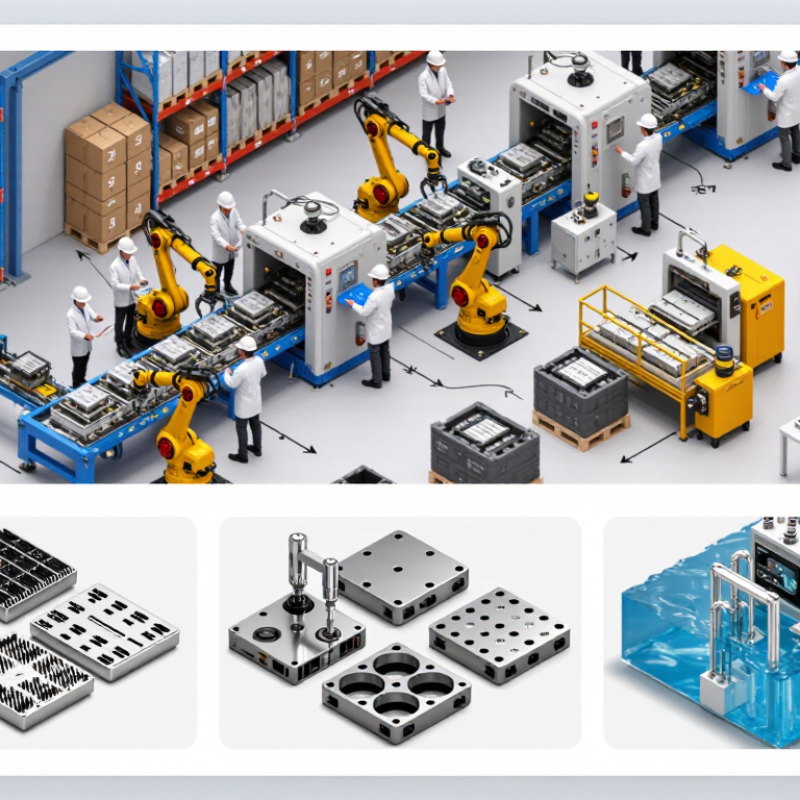
A cooler cold plate is a metal heat-transfer surface inside a cooling system. It usually uses aluminum or copper because both conduct heat efficiently. A coolant channel runs beneath the contact surface. Heat moves from the device into the plate, then into the flowing liquid. A pump carries that heat toward a radiator, chiller, or heat exchanger.
The process looks simple. It is not always simple. Contact flatness, thermal paste thickness, coolant flow, and channel design can change results. A small air gap may sharply increase thermal resistance. In field testing, technicians often find uneven mounting pressure near the plate corners. That detail is easy to miss. The U.S. Department of Energy identifies cooling as a major data-center energy load, often reaching 30–40% of facility consumption. Cold plates can reduce fan dependence, but only when the entire loop is properly designed.
The IEA’s Electricity 2024 report expects data-center electricity demand to rise substantially by 2026. Uptime Institute’s 2024 Global Data Center Survey also reports continuing pressure to improve cooling efficiency and rack density. These figures explain rising global interest in liquid cooling components. However, a cold plate alone does not guarantee lower energy use. Designers must check pressure drop, corrosion control, leak protection, service access, and long-term material compatibility. One uncomfortable point remains: laboratory performance may look excellent, while installation errors quietly reduce real-world efficiency.
| Cold Plate Type | Basic Construction | Cooling Medium | How It Works | Common Base Materials | Typical Thermal Conductivity of Base Material | Main Advantages | Typical Applications | Important Buyer Considerations |
|---|---|---|---|---|---|---|---|---|
| Liquid Channel Cold Plate | A machined, brazed, welded, or friction-stir-welded plate containing internal channels. | Water, water-glycol mixture, dielectric fluid, or other engineered coolant. | Heat is conducted from the component into the plate and then transferred to the flowing liquid through the channel walls. | Aluminum alloys, copper, copper alloys, or copper-aluminum combinations. | Aluminum 6061: approximately 167 W/m·K; copper: approximately 385–401 W/m·K at room temperature. | High heat-transfer capacity, compact design, and controllable coolant flow. | Power electronics, battery modules, laser systems, industrial drives, and high-power computing equipment. | Check pressure drop, flow rate, leak tightness, corrosion compatibility, channel cleanliness, and flatness. |
| Brazed Cold Plate | Several metal layers are joined by brazing to form sealed internal passages and external mounting surfaces. | Usually water, water-glycol, or a specified dielectric coolant. | Internal passages distribute coolant beneath the heat source, increasing the effective heat-transfer area. | Aluminum or copper, with a compatible brazing filler material. | Depends on the selected metal; aluminum and copper commonly provide approximately 167 W/m·K and 385–401 W/m·K, respectively. | Reliable sealed passages, repeatable production, and relatively complex flow-path capability. | Electric vehicle battery systems, converters, inverters, and industrial power modules. | Request burst-pressure data, leak-test standards, brazing quality controls, and dimensional inspection records. |
| Machined Cold Plate | Coolant grooves or channels are directly milled or drilled into a solid metal plate and then sealed with a cover. | Liquid coolant, most commonly water-based coolant. | Heat travels through the plate to the machined channels, where the moving coolant removes thermal energy. | Aluminum 6061, aluminum 6063, copper, or copper alloys. | Aluminum 6061: approximately 167 W/m·K; copper: approximately 385–401 W/m·K. | Flexible geometry, fast design changes, and suitability for prototypes or lower-volume production. | Testing equipment, prototypes, LED systems, laboratory equipment, and customized electronics. | Evaluate machining tolerance, channel geometry, sealing method, surface flatness, and production scalability. |
| Extruded Cold Plate | An aluminum extrusion forms longitudinal coolant passages and external mounting surfaces in one profile. | Air or liquid, depending on the profile and system design. | The extrusion increases surface area and conducts heat toward the coolant passages or external fins. | Aluminum alloys, commonly heat-treatable extrusion grades. | Typical aluminum alloys: approximately 150–235 W/m·K, depending on grade and temper. | Cost-efficient for long profiles, lightweight, and suitable for repeated cross-sectional designs. | Battery trays, motor controllers, LED lighting, telecommunications equipment, and industrial electronics. | Confirm profile availability, allowable cutting length, sealing arrangement, wall thickness, and dimensional tolerances. |
| Friction-Stir-Welded Cold Plate | Two or more metal sections are joined using a solid-state friction-stir-welding process after channels are formed. | Water, water-glycol, or application-specific liquid coolant. | The welded assembly creates sealed channels while maintaining a robust structural connection without conventional fusion welding. | Aluminum alloys; copper-based designs are also possible for specialized requirements. | Aluminum alloys typically range from approximately 150–235 W/m·K; copper is approximately 385–401 W/m·K. | Large-format construction, strong joints, low distortion, and good suitability for automotive and energy systems. | Electric vehicle battery packs, traction inverters, charging systems, and renewable-energy converters. | Review weld integrity, cross-section inspection, pressure testing, thermal resistance, and corrosion protection. |
| Vapor Chamber Cold Plate | A sealed flat chamber containing a working fluid and internal wick structure. | Internal phase-change fluid; no external liquid loop is required for the chamber itself. | Heat evaporates the internal fluid at the hot area. Vapor spreads through the chamber, condenses in cooler regions, and returns through the wick. | Copper, stainless steel, or copper-based composite structures. | Effective in-plane thermal conductivity can be several hundred to above 1,000 W/m·K, depending on design and operating conditions. | Excellent heat spreading, low profile, and passive phase-change operation. | LED modules, telecommunications equipment, compact electronics, power semiconductor assemblies, and mobile systems. | Check orientation limits, maximum heat load, operating temperature range, flatness, vacuum integrity, and mechanical durability. |
| Two-Phase Loop Cold Plate | A cold plate integrated with an evaporator-condenser loop or pumped two-phase cooling circuit. | A refrigerant or another selected two-phase working fluid. | The working fluid evaporates near the heat source and condenses elsewhere, transporting heat with latent heat rather than only sensible heat. | Copper, aluminum, stainless steel, or mixed-metal assemblies selected for fluid compatibility. | Base-material conductivity varies; copper is approximately 385–401 W/m·K and aluminum is approximately 167–235 W/m·K. | High heat-flux capability and efficient heat transport over longer distances. | Data-center processors, high-power laser systems, aerospace electronics, and advanced power-conversion equipment. | Require detailed qualification of fluid compatibility, operating pressure, system controls, safety compliance, and maintenance requirements. |
| Air-Cooled Cold Plate or Fin Plate | A metal plate with fins, pins, or extended surfaces that increase contact area with moving air. | Natural convection air or forced air from a fan or blower. | Heat conducts through the plate and is released to air across the enlarged fin surface. | Aluminum alloys or copper; aluminum is commonly selected for its lower weight. | Aluminum 6061: approximately 167 W/m·K; copper: approximately 385–401 W/m·K. | Simple installation, no liquid leakage risk, and lower system complexity. | LED lighting, control cabinets, power supplies, motors, and moderate-power electronic devices. | Consider airflow, acoustic limits, dust accumulation, fin spacing, ambient temperature, and available installation space. |
Technical note: A cooler cold plate is a heat exchanger or heat-spreading component installed between a heat-generating device and a cooling medium. Actual thermal performance depends on heat load, contact resistance, coolant temperature, flow rate, channel design, material, surface flatness, and manufacturing quality. Thermal-conductivity values are approximate room-temperature reference values and should not be used alone to predict complete system performance.