

Automated guided vehicles are moving from controlled factory floors into warehouses, hospitals, ports, and distribution centers. This shift makes Agv Technology more than a purchasing trend. It affects labor design, safety planning, software integration, and daily operating costs.
The International Federation of Robotics reported 541,302 industrial robots were installed worldwide in 2023. That figure does not measure AGVs directly, but it shows continuing investment in automation. Interact Analysis also identifies mobile robotics as a fast-growing part of warehouse automation, driven by e-commerce, labor shortages, and tighter delivery expectations. The MHI Annual Industry Report 2024 similarly highlights robotics and automation as major supply-chain priorities among industry leaders.
The practical question is not simply, “Which company sells the most vehicles?” It is whether a supplier can handle uneven floors, narrow aisles, mixed traffic, changing routes, and integration with warehouse management systems. A vehicle that performs perfectly in a showroom may struggle beside a loading dock at 6 a.m.
Former Amazon Robotics director Scott Anderson expressed the human-centered principle clearly: “We don’t view robots as replacing people; we view them as augmenting people.” That perspective remains important when comparing global AGV providers.
This guide examines ten leading Agv Technology companies through product range, navigation methods, software capability, deployment experience, service coverage, and scalability. No ranking is flawless. Regional integrators may outperform larger brands in specific industries, while lower-cost systems can sometimes deliver better value. Buyers should test claims against real workflows, measurable uptime, training requirements, and long-term support.
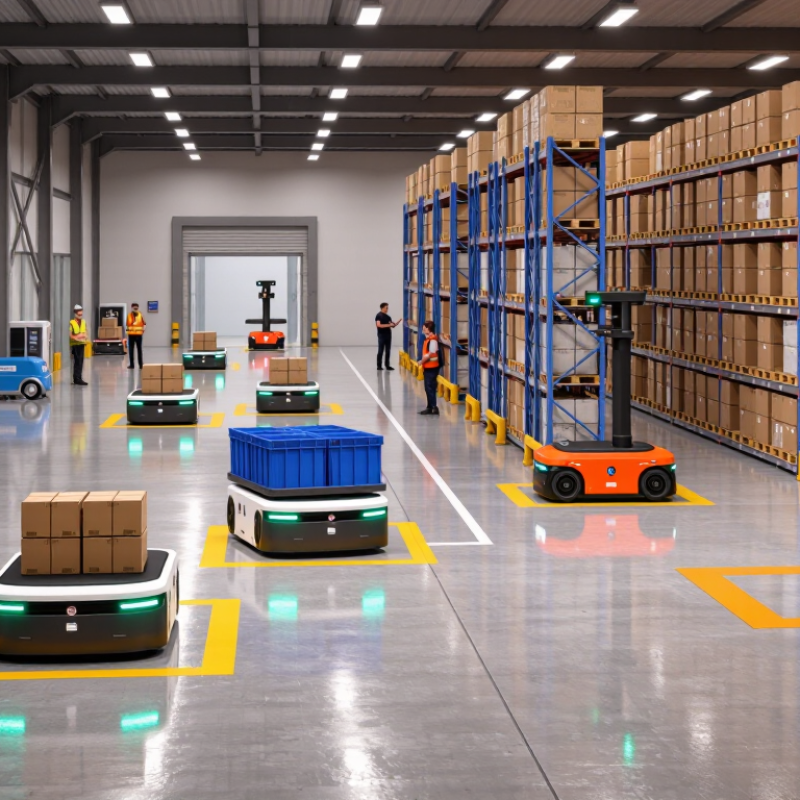
Automated guided vehicles (AGVs) transport materials through factories, warehouses, and distribution centers with repeatable accuracy. Their core functions include navigation, load handling, obstacle detection, fleet coordination, and battery management. An AGV may collect a pallet from a storage lane, pause at a crossing, and deliver it to a production station. Common guidance methods include magnetic tape, laser reflectors, QR markers, and mapped routes. Safety scanners, emergency stops, and load sensors help reduce collision and handling risks.
AGV types match different material flows. Towing vehicles pull several carts across long routes. Unit-load models carry boxes or pallets on built-in decks. Forklift AGVs lift palletized goods, while compact carts serve narrow production areas. Small details matter. Floor joints, aisle width, turning radius, and pallet quality can affect performance. In manufacturing, AGVs supply components beside assembly lines. In warehouses, they move finished goods between storage, picking, and shipping zones. Cold-storage facilities may also use them, but battery behavior and condensation require careful testing.
Reliable deployment begins with a site survey and measurable targets. Buyers should compare payload, travel speed, charging time, software integration, and maintenance support. Fleet systems commonly connect with warehouse or manufacturing software through documented interfaces. Safety planning should reference applicable requirements, including ISO 3691-4 where relevant. A pilot can track delivery accuracy, waiting time, battery usage, and near-miss events. Routes need discipline. A technically sound project can still struggle when workers bypass procedures or pallets vary in size. Human training, clear traffic rules, and regular inspections remain essential.
| AGV Technology Type | Core Function | Typical Navigation | Typical Payload | Typical Speed | Positioning Accuracy | Common Industrial Applications | Key Selection Considerations |
|---|---|---|---|---|---|---|---|
| Unit-Load AGV | Moves pallets, bins, totes, or containers between fixed loading and unloading points. | Magnetic tape, QR markers, laser guidance, or natural-feature mapping. | 500–2,000 kg | 0.8–1.5 m/s | Typically ±10–30 mm at transfer points. | Warehouses, assembly lines, packaging, and distribution centers. | Floor condition, transfer height, load dimensions, and interface compatibility. |
| Tugger AGV | Tows one or more carts in a train for repetitive line-side or warehouse replenishment. | Laser, magnetic guidance, QR codes, or mapped navigation. | 1,000–5,000 kg total train load | 0.6–1.2 m/s | Typically ±20–50 mm, depending on coupling and docking design. | Automotive, electronics, appliance, and manufacturing plants. | Turning radius, aisle width, trailer stability, and route congestion. |
| Forklift AGV | Automatically picks, transports, stacks, and retrieves palletized loads. | Laser navigation, reflector-based positioning, QR markers, or SLAM. | 1,000–3,000 kg | 0.8–1.5 m/s travel speed | Typically ±10–25 mm for pallet approach and placement. | High-bay warehouses, raw-material storage, cold chains, and factories. | Pallet quality, rack tolerances, floor flatness, safety zones, and lift height. |
| Pallet-Transport AGV | Lifts or carries pallets close to the floor and transfers them between workstations. | Natural-feature navigation, laser guidance, magnetic tape, or QR markers. | 500–1,500 kg | 0.8–1.5 m/s | Typically ±10–30 mm at docking locations. | Pallet staging, production feeding, finished-goods movement, and cross-docking. | Pallet entry clearance, conveyor height, load overhang, and docking repeatability. |
| Conveyor-Top AGV | Transfers cartons, totes, or pallets through powered roller or belt interfaces. | Laser, QR-code, magnetic, or mapped autonomous navigation. | 300–1,500 kg | 0.5–1.2 m/s | Typically ±10–20 mm for conveyor alignment. | Sortation, e-commerce fulfillment, parcel handling, and production logistics. | Conveyor height matching, load orientation, throughput, and communication protocols. |
| Cart-Based AGV | Carries custom carts, racks, work-in-process materials, or mobile fixtures. | SLAM, laser navigation, visual navigation, or floor markers. | 300–1,000 kg | 0.5–1.2 m/s | Typically ±15–40 mm. | Component kitting, assembly, healthcare logistics, and laboratory operations. | Cart coupling, load stability, aisle traffic, and workstation ergonomics. |
| Heavy-Load AGV | Moves large dies, coils, molds, engines, steel products, or other oversized loads. | Laser guidance, inertial navigation, wire guidance, or hybrid navigation. | 5,000–100,000+ kg | 0.2–0.8 m/s | Typically ±20–75 mm, based on load size and transfer requirements. | Steel, shipbuilding, aerospace, heavy equipment, and precast concrete. | Structural capacity, battery energy, emergency braking, surface strength, and turning geometry. |
| Cleanroom AGV | Transports sensitive materials in controlled environments with minimized particle generation. | Laser, magnetic, QR, or mapped navigation with controlled motion profiles. | 100–1,000 kg | 0.2–0.8 m/s | Typically ±10–30 mm. | Semiconductor, pharmaceutical, medical-device, and precision electronics production. | Cleanroom classification, materials of construction, particle control, and charging method. |
| Outdoor AGV | Performs automated transport across yards, docks, warehouses, or partially covered outdoor areas. | GNSS, LiDAR, radar, visual navigation, inertial sensors, or combined systems. | 1,000–40,000 kg | 0.5–2.0 m/s | Typically ±30–100 mm, depending on positioning technology and terrain. | Ports, logistics yards, construction-material sites, and inter-building transport. | Weather protection, drainage, lighting, road markings, connectivity, and mixed traffic. |
| Vision-Guided AGV | Uses cameras and computer vision to follow routes, recognize locations, and adapt to changing layouts. | Visual landmarks, 2D/3D cameras, LiDAR-assisted SLAM, or hybrid sensor fusion. | 100–2,000 kg | 0.5–1.5 m/s | Typically ±15–50 mm, subject to lighting and environmental conditions. | Flexible manufacturing, warehouses, hospitals, retail backrooms, and dynamic facilities. | Lighting variation, reflective surfaces, occlusion, floor markings, and data-processing capability. |
Note: Payload, speed, and positioning figures are representative industrial ranges. Actual performance depends on vehicle configuration, battery capacity, floor conditions, navigation method, safety requirements, and site layout.