

Choosing Carton Flow Racking Systems requires more than comparing prices, frame colors, or storage capacity. The right system must match carton dimensions, product weight, picking frequency, and warehouse conditions. In practical warehouse reviews, small details often decide performance. A carton may stop when its base is uneven. A fast-moving SKU may create congestion within hours. These issues are easy to overlook during a sales presentation.
There is no universal configuration. Good planning begins with accurate measurements and real operating data. Record each carton’s length, width, height, weight, and daily movement. Then evaluate roller pitch, lane depth, rack height, replenishment access, and FIFO requirements. Operators should test representative cartons, not only ideal samples. That assumption can fail.
Safety and maintenance also deserve serious attention. Frames must support the intended load, while dividers should prevent cartons from shifting between lanes. Brakes, rollers, labels, and back stops need routine inspection. Clear access improves picking accuracy and reduces unnecessary walking. Experienced suppliers can provide load calculations, layout drawings, installation guidance, and practical service advice. However, buyers should verify these claims through references, technical documents, and site-specific checks.
This guide explains how to choose Carton Flow Racking Systems with a balanced, evidence-based approach. It highlights useful questions, common planning mistakes, and trade-offs between density and accessibility. Perfect layouts are rare. A thoughtful, adjustable design usually performs better over time.
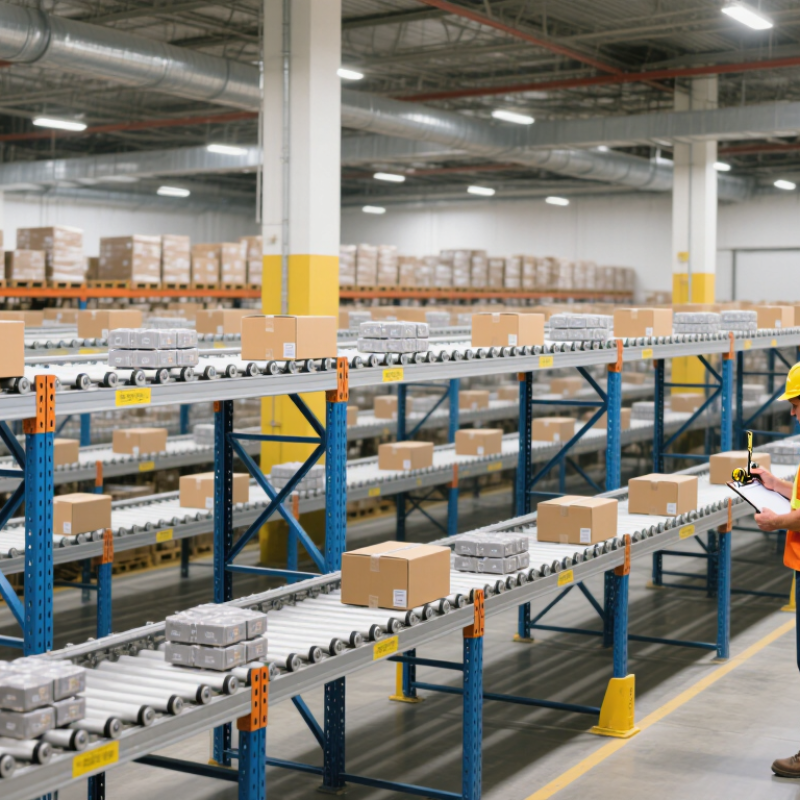
Carton flow racking should be defined by three operating facts: FIFO rules, SKU velocity, and load capacity. FIFO works best when cartons enter from the rear and roll toward the picking face. This layout keeps older stock visible and reduces expiry risk. It also needs disciplined replenishment. Without accurate date controls, FIFO becomes an assumption.
SKU velocity decides lane depth and replenishment frequency. Fast-moving items need short, accessible lanes near the dispatch area. Slow movers can use deeper lanes or higher positions. The 2023 Zebra Global Warehousing Study reported that 58% of warehouse decision-makers planned RFID adoption by 2028, showing the growing value of real-time inventory visibility. Yet technology cannot fix poor slotting. Review order history by day, not only monthly averages.
Load capacity must include carton weight, dimensions, roller spacing, and impact during replenishment. The 2024 MHI Annual Industry Report found that 55% of respondents planned to increase technology and innovation investment. That investment should support safer decisions, not simply denser storage. Confirm the rack’s rated capacity with an engineer or qualified supplier, and record every change in carton specification.
Tips: Mark FIFO entry and pick faces clearly. Measure the heaviest carton. Test one lane with real operators before expanding. A perfect design is rare. Measure twice. Recheck velocity after promotions, seasonality, and packaging changes.
Start with the active SKU count. Do not count discontinued items or reserve stock locations. If 480 SKUs require forward picking, plan for at least 480 pick faces. Some fast-moving SKUs need two or more faces. This reduces replenishment interruptions and picker travel.
Daily lines show workload, but peak-hour demand sizes the system. Assume 1,200 daily order lines, with 30% arriving during the busiest hour. That creates 360 peak-hour lines. If one pick face supports 12 lines per hour, capacity requires 30 productive faces. However, SKU coverage still requires 480 faces. The larger requirement governs the layout. For fast movers, divide their peak-hour lines by the practical rate per face. Round upward, then add spare capacity for replenishment and seasonal surges.
Measure actual pick rates in the operating aisle. A clean test may show 12 lines per hour, while congestion reduces that number to nine. That difference matters. Keep 10% to 20% expansion space when forecasts are uncertain. It is not always efficient to fill every carton flow lane. Empty space can protect access and improve replenishment timing. Review the calculation after four weeks of real orders. Early assumptions are often wrong, especially when promotions change the demand pattern.
How to Choose Carton Flow Racking Systems?
Carton flow racking works best when its geometry matches real carton behavior. Specify a track slope of 3–5% to maintain steady movement without harsh acceleration. A 3% slope may suit lighter cartons and shorter lanes. Heavier cartons often need closer testing near 5%. More slope is not automatically better.
Roller pitch must support the carton base continuously. Measure the smallest carton, then confirm that at least three rollers support it during travel. Common layouts use closer roller spacing for narrow or flexible cartons. Set clear weight limits for each carton size and lane. Do not rely only on average carton weight. A dense carton can behave differently from a light carton with the same dimensions. In practice, sample testing reveals problems that drawings miss.
Tips: Test loaded cartons on a full-scale section. Check starting movement, stopping distance, and picking access. Keep heavier cartons in lower lanes when possible. Inspect rollers for dust, dents, and uneven resistance. A neat calculation can still fail. I have found that mixed carton quality often changes performance more than expected. Leave adjustment room in the track design, because real packaging is rarely perfectly uniform. Record the tested carton dimensions, weights, and slope settings for future maintenance.
Specify a 3–5% track slope, select the roller pitch according to carton dimensions, and verify the maximum carton weight through testing.
The chart presents typical engineering planning values for carton flow lanes. A 50 mm roller pitch provides more support for smaller or flexible cartons, while 75–100 mm pitches are generally suited to rigid cartons with a flat base. A 3–5% slope is commonly used to maintain carton movement; the final weight limit should be confirmed with the actual carton, roller type, lane length, and braking requirements.
How to Choose Carton Flow Racking Systems?
Single-sided carton flow racking suits wall lines, narrow pick zones, and selective replenishment. Pickers face one flow lane, while replenishment occurs from the rear or adjacent aisle. This layout can reduce aisle conflicts, but it uses more wall length per picking face. A 900–1,200 mm pedestrian aisle may work for hand picking, depending on carton size, turning space, and safety assessments. Do not treat this range as a universal rule.
Double-sided layouts place flow lanes back-to-back. One shared aisle serves both faces, increasing pick density within the same floor area. They often fit higher-volume zones with similar products on opposite sides. However, two pickers may meet beside open cartons. Congestion appears quickly when replenishment enters the same aisle. Test the layout during the busiest hour, not during a quiet site visit.
The 2024 MHI Annual Industry Report states that 83% of supply-chain leaders plan to increase technology investment over the next five years. That pressure makes measurable pick density important, but automation cannot repair poor slotting. Track picks per labor hour, replenishment frequency, travel distance, and blocked locations. WERC’s DC Measures research also emphasizes benchmarking labor and space performance across distribution operations. My practical preference is simple: choose double-sided flow when demand is balanced and aisle control is strong. Choose single-sided flow when access, visibility, or product changes matter more. Sometimes, the narrower design performs worse. Test it.
| Evaluation Dimension | Single-Sided Carton Flow | Double-Sided Carton Flow | Planning Implication |
|---|---|---|---|
| Typical location | Installed against a wall or at the edge of a pick module | Installed as a central rack, with carton flow lanes facing both sides | Use single-sided runs where wall space is available; use double-sided runs to create denser central pick modules. |
| Recommended manual aisle width | Approximately 900–1,200 mm | Approximately 1,200–1,500 mm between opposing pick faces | Confirm the final width using worker movement, tote dimensions, order volume, and local safety requirements. |
| Aisle width with carts or order-picking equipment | Usually about 1,200–1,800 mm, depending on cart size and turning method | Usually about 1,500–2,100 mm where carts pass or operators work simultaneously | Use the equipment manufacturer's turning and clearance requirements rather than selecting an aisle width by rack type alone. |
| Pick-face access | Access is available from one operating side | Access is available from two operating sides | Double-sided layouts can separate product families or order flows by facing without adding another rack row. |
| Approximate pick-face density per rack footprint | Baseline: 1.0 usable pick face per rack position | Up to approximately 2.0 usable pick faces per rack position when both sides are fully utilized | Double-sided racks can increase SKU access density, but the wider shared aisle reduces part of the space benefit. |
| Suitable pick density | Low to medium: about 20–60 active picks per labor hour per operator, depending on travel and replenishment | Medium to high: about 40–100 active picks per labor hour per operator when SKU placement and batching are well controlled | These are planning ranges, not guaranteed rates; item size, order profile, walking distance, and scan procedures strongly affect actual performance. |
| Storage utilization | Lower when the opposite side of the aisle is unused or when racks are placed only along perimeter walls | Higher in compact modules because one rack structure serves two pick faces | Compare total module width, aisle width, replenishment access, and required fire or egress clearances—not rack depth alone. |
| Replenishment method | Replenishment and picking normally occur from the same face | Can support front picking with replenishment from the opposite side when the rack is configured for two-direction operation | Separate replenishment and picking paths can reduce interference during busy periods. |
| Best use case | Small operations, perimeter picking, low-volume SKUs, or layouts requiring simple expansion | High-volume piece picking, fast-moving SKU zones, and operations requiring many accessible pick faces | Choose the layout that matches SKU velocity and order-line concentration, not only the available floor area. |
| Expansion flexibility | Generally easier to extend along a wall or add separate runs | Efficient for planned modules, but changes may affect both pick faces and shared aisle traffic | Leave space for future lanes, end-of-aisle maneuvering, replenishment staging, and emergency access. |
| Key decision rule | Select when simplicity, wall utilization, or gradual growth is the priority | Select when high pick-face density and reduced travel per order line justify a wider shared aisle | Validate the design with a measured time study using actual SKU dimensions and order-line data. |
How to Choose Carton Flow Racking Systems?
Carton flow racking should support safe, accurate, and comfortable picking. Begin by verifying the system’s rated load, frame strength, wheel capacity, and anchoring method. Ask for documented test results and installation guidance. Requirements can vary by location, so confirm applicable workplace safety standards with a qualified inspector. Never rely on appearance alone. A strong-looking frame may still be overloaded.
Ergonomics affects every carton handled during a shift. Select shelf heights that keep common products between knee and shoulder level. Rollers should move cartons smoothly without sudden drops. Add label holders, clear aisle space, and suitable lighting. Workers should not twist repeatedly or reach across unstable stock. I once underestimated the effect of shelf height; small discomfort became slower picking by afternoon. That mistake was useful, but avoidable.
Tips: Check the heaviest carton first. Test several carton sizes before ordering. Leave space for hand clearance. Inspect rollers, stops, frames, and anchors on a scheduled basis. Keep spare parts available for common wear items. Compare total cost of ownership, not only purchase price. Include installation, training, inspections, repairs, replacement rollers, and future capacity changes. A cheaper system can become expensive when maintenance is difficult. Still, cost estimates are imperfect. Review actual picking data after three months and adjust the layout when evidence shows a better option.
Contact Us
Pemamek Ltd