China Top 10 Cell Phone Box Making Machine Manufacturers?
China has become a major production base for packaging equipment, including the Cell Phone Box Making Machine. Its factories serve smartphone brands, contract packers, and printing companies worldwide. However, choosing a supplier requires more than comparing catalog prices.
This guide examines ten leading Chinese manufacturers through practical criteria. These include forming accuracy, paperboard compatibility, production speed, automation, glue control, and after-sales support. A reliable machine should create sharp corners, clean edges, and consistent folding. It should also handle coated paper, greyboard, specialty paper, and different box structures without frequent adjustments.
Packaging machinery engineer Chen Wei explains, “A good box machine is judged by repeatable accuracy, not by impressive speed alone.” That point deserves attention. A fast machine can still waste materials when its alignment drifts. Small errors become visible on a premium phone box.
The manufacturers in this review are not ranked by marketing claims alone. Their equipment should be assessed through factory visits, sample production, technical documentation, and customer feedback. Service response also matters. A delayed replacement sensor can stop an entire packaging line.
Some companies may appear highly capable, yet their overseas support remains limited. Others offer slower machines but stronger customization. There is no universal winner. Buyer expectations, box design, order volume, and available floor space all influence the final decision.
This comparison may not answer every purchasing question. It should encourage closer examination. Before signing an order, request trial samples and confirm installation responsibilities. The best Cell Phone Box Making Machine is the one that performs reliably in your real production environment.
Global Smartphone Demand: 1.17 Billion Units Shipped in 2023
China Top 10 Cell Phone Box Making Machine Manufacturers?
Global smartphone demand reached approximately 1.17 billion units in 2023, according to IDC’s Worldwide Quarterly Mobile Phone Tracker. Shipments fell 3.2% from 2022, but replacement demand and emerging markets still support large packaging volumes. The pressure is real. Every shipment needs a protective, presentable box, often with precise inserts, printed surfaces, and recyclable paperboard.
For Chinese box-making machine manufacturers, this market requires more than high speed. A practical production line may combine die cutting, creasing, folding, gluing, and quality inspection. Buyers should check output consistency, setup time, waste rates, and compatibility with different board thicknesses. Canalys reported that global smartphone shipments recovered in late 2023, although regional performance remained uneven. That uncertainty makes flexible equipment valuable for short runs and changing box dimensions.
In factory trials, operators should inspect corner sharpness, lid alignment, adhesive control, and surface scratches under strong light. Small faults become expensive when thousands of boxes are stacked for export. Automation can reduce repetitive labor, yet it cannot replace disciplined maintenance or skilled adjustment. A faster line is not always a better line. I would not treat one forecast as certainty; shipment data changes, and packaging investment should follow measured orders, not optimism.
Cell Phone Box Machines: Die-Cutting, Folding, Gluing, and Rigid-Box Lines
Cell Phone Box Machines: Die-Cutting, Folding, Gluing, and Rigid-Box Lines
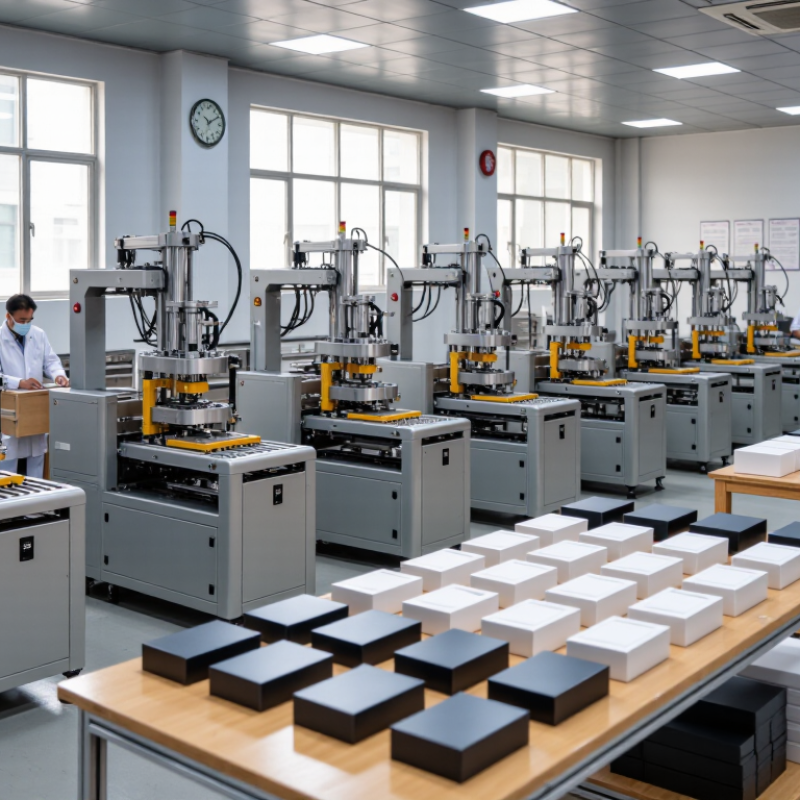
China’s cell phone box machine sector serves high-volume packaging with increasingly tight tolerances. Die-cutting machines shape coated paperboard, often keeping ±0.1 mm registration when properly maintained. This matters around camera openings, magnetic closures, and shallow embossing. Alignment matters. A misplaced crease can make a premium box feel cheap.
Smithers’ The Future of Folding Cartons to 2028 reports continued growth in folding-carton demand, supported by consumer electronics and premium presentation. Its analysis also points to automation, shorter runs, and sustainable substrates as important equipment pressures. For phone packaging, servo-driven die-cutters reduce setup waste, while folding and gluing lines improve repeatability at speeds commonly exceeding 100 boxes per minute. Actual output depends on board stiffness, adhesive curing, and operator skill.
Rigid-box production requires different thinking. Corner-pasting units, board wrapping systems, and pressing stations must control surface tension without marking soft-touch paper. Industry packaging studies from PMMI consistently identify labor availability and changeover time as major automation concerns. That evidence should shape machine selection, not only catalog speed. A supplier may quote impressive capacity, yet testing with real board, foil, and inserts can reveal slower results. This is where many purchasing plans become too optimistic. A reliable manufacturer should provide sample runs, maintenance records, safety documentation, and measurable waste data before installation. 马会
Key Technical Metrics: 250–400 gsm Board, ±0.1 mm Precision, and OEE
China Top 10 Cell Phone Box Making Machine Manufacturers?
When comparing China’s top 10 cell phone box making machine manufacturers, focus on measurable output, not showroom speed. Machines should process 250–400 gsm board without cracking, whitening, or unstable feeding. This range suits many rigid and folding phone packages. Smithers’ folding carton market analysis projects roughly 4–5% annual growth through 2028. That growth increases pressure on repeatable quality.
A ±0.1 mm precision target matters around magnetic closures, trays, and printed edges. However, this figure may describe positioning, not finished-box accuracy. Ask for test samples using your board, adhesive, and artwork. Measure ten consecutive boxes, not one perfect sample. Check creasing depth, die-cut registration, glue-line position, and rejection rates. Small humidity changes can distort board quickly.
OEE deserves equal attention. Vorne’s OEE Industry Report identifies 85% as a world-class benchmark, while average manufacturing performance remains near 60%. ISO 22400 also separates availability, performance, and quality, preventing vague productivity claims. A machine running fast but producing rejects has weak OEE. Request logged data for speed, downtime, changeover minutes, and quality losses. I would not accept an impressive brochure number without a factory trial. That is where assumptions usually fail.
China Cell Phone Box Making Machine Technical Benchmark
Reference comparison of non-branded machine capability bands using board compatibility, positioning tolerance, and overall equipment effectiveness (OEE). Lower positioning tolerance indicates higher precision.
Reference ranges: 250–400 gsm folding-carton board, approximately ±0.08–0.15 mm positioning tolerance, and 70–85% OEE under stable production conditions. Values are technical benchmark references, not manufacturer-specific claims.
Supplier Comparison: Price, Lead Time, Energy Use, and After-Sales Coverage
China’s top-ten cell phone box machine suppliers should be compared by operating value, not catalogue price. PMMI’s 2023 Packaging Machinery Shipments Report recorded North American shipments above US$10 billion, showing strong demand for automated packaging equipment. However, regional prices vary widely. Basic folding and rigid-box machines often quote between US$30,000 and US$120,000. Integrated lines can exceed US$200,000. These are practical quotation ranges, not fixed market prices.
Lead time deserves equal attention. Standard equipment may ship within 45–90 days, while customized feeding, gluing, or inspection systems can require 120–180 days. Ask for a signed production schedule and factory acceptance test. Request proof of output speed using your actual board, film, and box dimensions. Small details matter. A cheap machine may become expensive after repeated adjustments.
Energy use should be measured per 1,000 finished boxes. Typical installed power ranges from 8 to 25 kW for mid-sized systems, but actual consumption depends on speed and idle time. The International Energy Agency reported that industry uses roughly 37% of global final energy, making efficiency a serious purchasing factor. Confirm motor efficiency, standby settings, compressed-air demand, and noise levels.
After-sales coverage should include remote diagnosis, stocked spare parts, multilingual manuals, and engineer response times. Some suppliers promise fast support, yet define it poorly. That gap needs scrutiny. Use ISO 12100 risk documentation and documented training records before comparing the final ten offers.