

Blue-Cut Lens products are widely marketed for screen use, but their performance depends on more than a blue-reflecting coating. Buyers comparing Chinese manufacturers should examine lens material, coating consistency, optical clarity, testing records, and export experience. A polished product photo proves little. Clear documentation matters.
Evidence deserves equal attention. A 2023 Cochrane systematic review assessed 17 randomized trials involving 619 adults. It found little support for blue-light-filtering spectacles improving short-term eye strain, visual performance, or sleep. Dr. Jennifer L. Downie, an optometrist and lead author of the review, stated: “The findings of this systematic review do not support the use of blue-light filtering spectacle lenses for the general population to improve visual performance, alleviate symptoms of eye strain or improve sleep quality.” This is a useful caution, not a verdict on every lens or every wearer. Claims need context.
This Top 10 guide compares Chinese manufacturers through practical indicators: product range, coating options, quality-control information, customization, and communication. It does not treat marketing language as clinical proof. Readers should request current specifications and independent test reports before placing an order. Some supplier details may change, and that limitation is worth acknowledging. The aim is a more informed shortlist—not a promise that one Blue-Cut Lens will suit everyone.
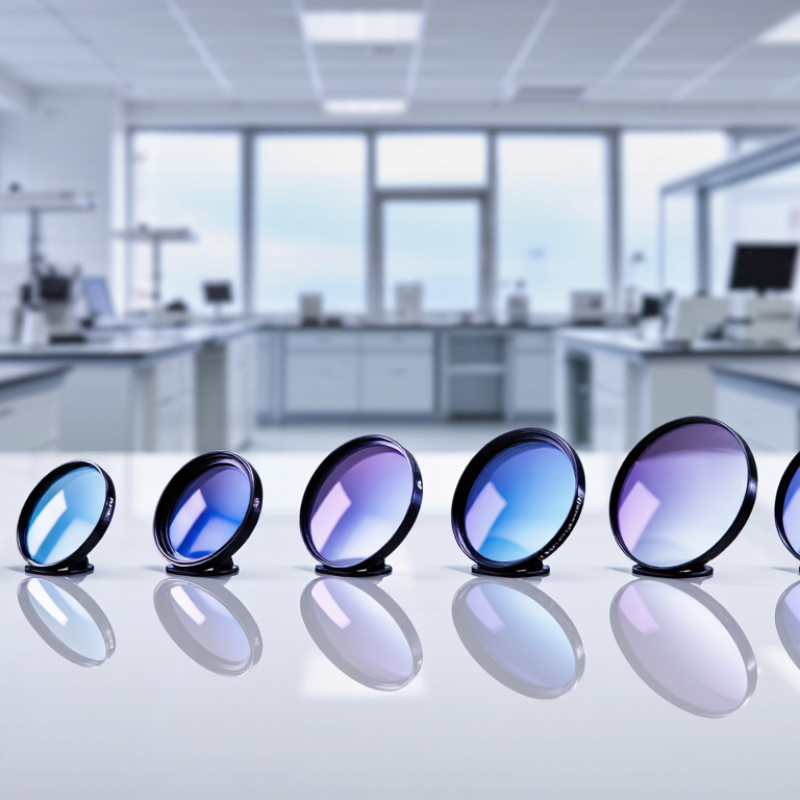
Blue light is part of visible light, not a single, uniform ray. The 400–500 nm band includes violet-blue wavelengths near its lower end and brighter blue-cyan light toward its upper end. Not all blue-cut lenses filter this range in the same way. Some reduce transmission across a broad section; others target a narrower portion. A lens may look almost clear, while another has a noticeable yellow tint. Appearance alone tells you little.
The spectral curve matters.
When comparing lens manufacturers, ask for a transmission chart showing performance across 400–500 nm, not just a single “blue-light blocking” percentage. Check the test conditions and the wavelengths covered. Small details matter. A higher filtering rate is not automatically better for every wearer, and color changes can affect how screens and printed materials look.
In a shop, compare a white page through the lens under ordinary lighting. It is a simple check, though hardly a laboratory test. Claims about comfort or sleep should also be read carefully; results can vary, and the evidence is not identical for every use.
No one chart answers every question.
For China’s blue-cut lens manufacturers, the meaningful comparison is how each lens controls wavelengths, not the label alone. Absorptive lenses use selective dyes or additives within the lens material, reducing transmission through its full thickness. They may add a slight amber cast. Coated lenses use thin-film layers to reflect selected wavelengths; some designs combine both methods. Ask for a spectral-transmittance curve rather than a single “blocking rate.” It should identify the tested wavelength range and conditions. Small details matter. A claimed 40% reduction means little without knowing which wavelengths were measured.
Spectral transmittance, written T(λ), shows how much light passes through at each wavelength. Compare the curve across the stated blue-light band, alongside visible-light transmission and color neutrality. The 2023 Cochrane review included 17 randomized trials and 619 adults; it found little evidence that blue-light filtering lenses reduce short-term visual fatigue. That is a useful restraint: transmission data alone cannot prove comfort or sleep benefits. The CIE’s 2019 position statement on the blue-light hazard also emphasizes wavelength-weighted exposure, not a simple blue-versus-not-blue cutoff. A darker lens is not automatically a stronger filter. Look closely. Request test results from spectrophotometry, and check whether the measurement conditions are clearly reported. Those conditions can change the story.
Blue-cut lens claims should be checked against a wavelength-by-wavelength transmission curve, not a single “filtering percentage.” ISO 8980-3:2022 describes transmittance specifications and test methods for spectacle lenses. A laboratory spectrophotometer can record how much light passes through each lens sample across the visible spectrum. Ask for the tested wavelength range, sample thickness, and whether results are absolute or averaged. The 400–500 nm band is commonly used for blue-light comparisons, but the chosen boundaries matter. A lens may block more near 420 nm and transmit more near 480 nm. One number can hide that difference.
Tips: Request the raw spectral curve and test conditions. Compare like with like.
IEC 62471:2006 evaluates photobiological safety using a blue-light hazard weighting function; it is not a simple product-ranking test. Look for the standard, instrument details, and repeatability data in a manufacturer’s report. Check whether the curve represents one lens or several samples. Small variations in tint and coating can affect readings. A clear lens with modest filtering may look less dramatic, yet its data can be easier to interpret. That distinction is easy to overlook.
Testing framework, not a manufacturer ranking: The entries below describe wavelength ranges and data fields used to evaluate blue-light filtering. They do not represent measured results for specific manufacturers or products. Actual transmittance values require testing of identified lens samples.
| No. | Test dimension | Wavelength or calculation | Data to report | Interpretation and data note |
|---|---|---|---|---|
| 1 | Ultraviolet B coverage | 280–315 nm | Spectral transmittance, T(λ), across the band; identify the scan interval and resolution. | UVB is a conventional ultraviolet wavelength region. UV filtering should be reported separately from blue-light filtering. |
| 2 | Ultraviolet A coverage | 315–400 nm | Spectral transmittance across the band, including the upper end near 400 nm. | UVA is conventionally defined as 315–400 nm. Different test methods may specify different reporting details. |
| 3 | Visible-light coverage | Approximately 380–780 nm | Full spectral-transmittance curve and any declared visible-light summary value. | This is a commonly used visible-range convention. The exact range used for a reported summary should be stated. |
| 4 | Blue-violet sub-band | 400–455 nm | Transmittance at selected wavelengths and the mean or integrated value for the stated band. | This sub-band is used in some blue-light discussions, but it is not a universal definition of “blue light.” |
| 5 | Blue-light band | 400–500 nm | Transmittance curve and a clearly defined band summary. | 400–500 nm is a commonly used operational band for blue-light comparisons; a report should disclose its chosen definition. |
| 6 | Spectral transmittance | T(λ) = transmitted spectral power ÷ incident spectral power × 100% | Transmittance in percent at each measured wavelength, with the instrument’s wavelength interval and resolution. | Lower transmittance at a wavelength means less light at that wavelength passes through the tested lens under the measurement conditions. |
| 7 | Unweighted band-average transmittance | For a continuous scan: average T(λ) over the declared band, such as 400–500 nm. | Report the band limits, averaging method, and resulting percentage. | An unweighted average treats wavelengths within the selected band equally. It is not interchangeable with a weighted value. |
| 8 | Selected-wavelength values | Example reporting points: 400, 420, 450, 480, and 500 nm. | Give T(λ) at each point, or state that values were interpolated from a measured spectrum. | These are suggested comparison points, not a claim that every standard requires this exact set. |
| 9 | Weighted blue-light transmittance | Weighted average of T(λ) using a disclosed spectral weighting function over a disclosed wavelength range. | Name the weighting function, wavelength limits, calculation method, and final percentage. | Weighted results depend on the selected function and range. They should not be compared directly when calculation methods differ. |
| 10 | Sample and test conditions | Record lens material, sample thickness, coating or tint, orientation, instrument, and test setup. | Identify the tested sample and provide the measurement method, calibration status, and any repeat measurements. | These details help make results reproducible. A generic “blue-light blocking” percentage without its wavelength range and method is incomplete. |
Note: Wavelength bands shown here are conventional or commonly used reporting ranges, not product-performance thresholds. No manufacturer-specific transmittance data or ranking is provided.
China’s blue-cut lens manufacturers offer products across several material and design categories. Common options include resin, polycarbonate, and high-index lenses, with clear, tinted, or photochromic versions. Some factories also support prescription processing, edging, and private-label packaging. Capabilities vary, so a broad product list does not always mean strong technical control.
Look closely at how each supplier verifies blue-light transmission. Ask for test data showing the measured wavelength range, visible-light transmission, and color shift. A lens that appears neutral under indoor lighting may look different beside a white screen. Small details matter. Buyers can also request samples and compare coating uniformity, surface scratches, and optical clarity under consistent lighting. No single lens suits every wearer.
Production capacity is only part of the picture. Reliable suppliers should explain material sourcing, inspection steps, defect handling, and lead times in clear terms. Their ability to manage prescription accuracy and repeat orders is equally relevant. Ten manufacturers may look similar in a catalogue, yet differ in testing depth and after-sales support. This comparison can be imperfect; published specifications do not always reveal how a factory handles a real production problem. A practical review should weigh documented performance against sample quality and communication.
Comparing blue cut lens manufacturers in China requires more than checking a catalogue or a quoted price. Ask suppliers which optical standards their products are tested against, and request current, product-specific reports. For spectacle lenses, ISO 8980-3 covers transmittance specifications, while ISO 14889 addresses basic requirements. Confirm the report matches the lens material and coating you plan to order. Numbers need context.
Quality control should be visible in the production process. Ask how technicians check lens power, transmission, surface defects, and coating adhesion. A spectrophotometer reading can show how much blue-violet light passes through, but test conditions matter. Request sample measurements and batch records, not just a general certificate. Small differences can affect comfort and appearance. That matters.
Customization is another useful comparison point. Check available refractive indices, prescription ranges, coating options, tint levels, and packaging. Clarify minimum order quantities and how the supplier handles revisions to a sample. If possible, compare finished lenses under the same light, using identical test methods. One weakness in many evaluations is relying too heavily on sales claims; I have seen neat specification sheets leave practical questions unanswered. Ask for evidence, and keep the questions specific.
Contact Us
Pemamek Ltd