China Best Power Factor Correction CKD Supplier?
Selecting a China-based supplier for Power Factor Correction CKD equipment takes more than comparing prices. A cabinet may look tidy in a product photo, yet perform poorly when loads change during a shift. Buyers should examine capacitor ratings, reactor options, controller settings, enclosure details, and the supplier’s testing records. Ask for clear drawings and component specifications. Small details matter.
Power-quality researcher Ewald Fuchs co-authored Power Quality in Power Systems and Electrical Machines. A useful engineering principle, consistent with this field, is: “Measure the load before choosing the correction.” This is an editorial summary, not a verified quotation from Fuchs. It reflects a practical point: the right solution depends on the site’s load profile, harmonics, voltage, and operating conditions. A supplier should be able to explain those choices in plain language, not just send a catalog.
For a CKD arrangement, also confirm what arrives as a kit, what is assembled locally, and how parts are identified. Request sample inspection records, wiring diagrams, and a realistic lead-time schedule. Then check whether technical support continues after delivery. A polished offer is not proof of dependable service. Some buyers may still focus too heavily on unit price; that is understandable, but worth reconsidering. The strongest supplier is the one that can support each claim with specific documents, measured results, and responsive engineering help.
Understanding Power Factor Correction Systems and CKD Supply
Power factor correction reduces reactive current, but the right system depends on the actual load profile. The U.S. Department of Energy’s 2014 sourcebook estimates motor-driven systems use about 68% of electricity in U.S. manufacturing. That scale makes careful measurement worthwhile. A facility with large motors, variable-speed drives, or frequent load changes may need staged correction rather than fixed capacitor banks. Not plug-and-play.
In a CKD supply arrangement, capacitors, switching devices, protection components, controllers, and enclosures ship separately for local assembly. The supplier should provide clear wiring diagrams, ratings, assembly checks, and commissioning guidance. Before shipment, confirm system voltage, target power factor, duty cycle, and available fault-current data. Missing details can turn a compact kit into hours of site troubleshooting.
Harmonics also deserve attention. Capacitors can interact with harmonic-producing equipment, so engineers should review measurements and consider detuned reactors where appropriate. IEEE 519-2022 provides guidance for harmonic control at points of common coupling; it does not replace project-specific analysis. One awkward reality: many plants lack reliable interval data. A short measurement campaign can improve sizing, but rushed estimates still happen. Ask for test records and a parts list that matches the drawings.
How CKD Power Factor Correction Equipment Is Assembled
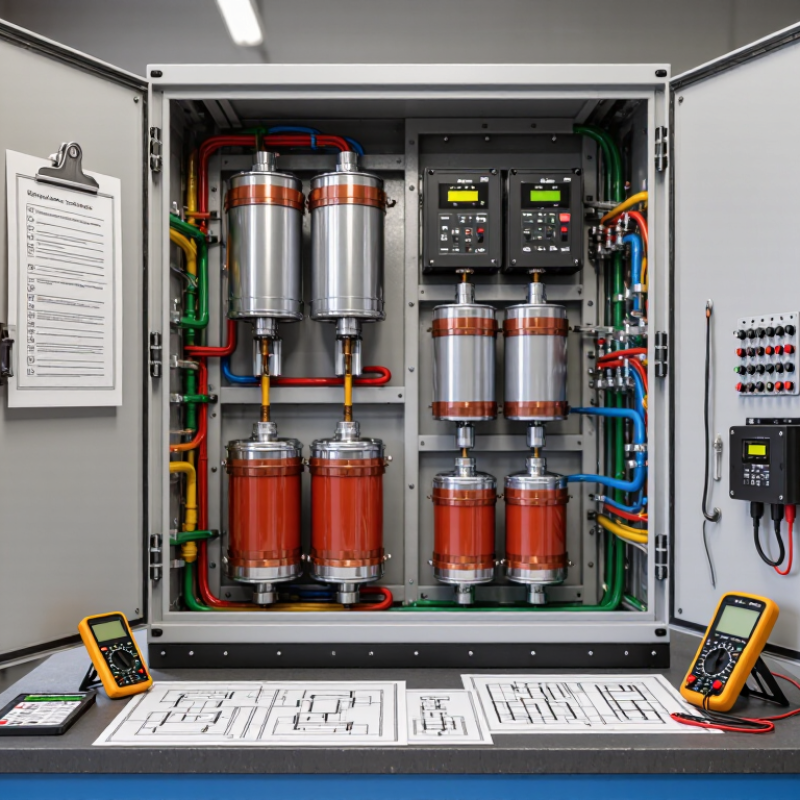
CKD power factor correction equipment arrives as separate, checked components rather than a finished cabinet. Assembly begins with matching capacitors, switching devices, reactors, controller, and enclosure against the approved bill of materials. Technicians inspect each part for shipping damage and confirm ratings before installation. Small details matter. A misplaced rating label can slow commissioning later.
The enclosure is prepared with mounting rails, ventilation openings, and protective earth connections. Capacitor banks and reactors are fixed in their specified positions, with clearance for airflow and maintenance. Busbars and cables are then fitted, keeping phase identification consistent throughout the cabinet. Installers tighten connections to the specified torque; guessing is not a reliable shortcut. The controller and current transformer wiring are connected according to the site diagram, with transformer polarity checked carefully. Layouts can differ between projects, so copying another cabinet without review is a weak practice.
Before energizing, the team checks wiring, insulation, grounding, and capacitor values. Functional tests should confirm that the controller switches stages smoothly under changing load. Tips: Photograph terminal layouts before wiring. Record torque and test results. Recheck airflow after the cabinet is fully assembled.
Power Factor Correction: Capacitor Bank Sizing for Assembly
These values are calculated for an assumed 100 kW load, correcting each starting power factor to 0.95. During assembly, capacitor stages are selected to provide the required reactive power. Actual equipment sizing should use measured load data and an electrical engineer’s assessment.
Key Components and Applications of PFC Systems
China Best Power Factor Correction CKD Supplier?
Key Components and Applications of PFC Systems
A power factor correction system supplies reactive power close to inductive loads, such as motors, pumps, and compressors. Capacitor banks provide the correction. A controller reads current through a current transformer and switches capacitor steps as demand changes. Contactors suit steadier loads; thyristor switches respond faster to frequent changes. Detuned reactors help limit harmonic amplification. Small details matter. Poorly specified protection or ventilation can shorten capacitor life, especially in a hot, dusty control room.
PFC systems are common in factories, commercial buildings, and water-treatment plants. The U.S. Energy Information Administration’s 2023 Electric Power Annual reports that industrial customers represented about 26% of U.S. electricity sales in 2022. That scale makes power quality an operational concern. Still, correction does not reduce the active energy a machine needs; it can reduce current and ease loading on upstream equipment. For a CKD supplier, request the site voltage, load profile, harmonic measurements, required kvar, and enclosure temperature. Ask for component test records too. A nameplate alone is not enough.
Criteria for Evaluating Chinese PFC CKD Suppliers
China Best Power Factor Correction CKD Supplier?
Criteria for Evaluating Chinese PFC CKD Suppliers
A reliable PFC CKD supplier should provide more than a low quotation. Check whether the kit includes capacitors, reactors, switching devices, controllers, and clear wiring diagrams. Ask for rated voltage, kvar steps, temperature limits, and component tolerances. These details help confirm that the package suits your panel and load profile. Good documentation matters.
Review quality controls before placing an order. Request inspection records, component traceability, and a sample test report. For a practical check, compare the stated step sequence with your expected load changes. Ask how the supplier tests switching, ventilation, and harmonic conditions. A tidy datasheet is useful, but it cannot prove field performance. I would verify critical values twice; small mismatches can cause delays.
Tips: Share your operating voltage, load variation, and installation environment early. Ask for a written bill of materials and clarify what CKD assembly support includes. Check packaging for moisture protection and labels that remain readable after shipping. Response speed is helpful, but technical answers matter more. One detail is easy to miss: confirm revision control for drawings and settings.
Supplier Verification, Compliance, and Procurement Considerations
Supplier verification for a China-based power factor correction CKD supplier should begin with traceable evidence, not a polished catalogue. The IEA’s 2011 report, Energy-Efficiency Policy Opportunities for Electric Motor-Driven Systems, estimated that motor-driven systems use about 46% of global electricity. That figure is not a promise of savings from correction equipment. It does show why correct ratings and installation conditions matter. Ask for capacitor and reactor specifications, routine test records, serial-number traceability, and clear warranty terms. Paperwork matters. Check that stated voltage, frequency, kvar output, and harmonic limits match the project’s load profile. A mismatch may look small on paper, but it can affect service life.
For compliance checks, request documentation against the relevant editions of IEC 60831-1 for low-voltage shunt capacitors and IEC 61921 for low-voltage power factor correction banks, where applicable. Confirm that test reports identify the actual product configuration, rather than a similar model. Also review factory quality procedures, incoming-material checks, and inspection records before approving samples. A sample alone is not proof. For procurement, compare lead times, replacement-part availability, packaging protection, and response times for technical questions. I would still hesitate if a supplier cannot explain how its ratings were verified. That is worth questioning. Keep the evaluation record, including deviations and open issues, so purchasing decisions remain auditable across engineering and procurement teams.