China Best Commercial Spray Dryer Manufacturer?
Choosing China’s best Commercial Spray Dryer manufacturer requires more than comparing prices or factory photographs. Buyers need to match the dryer to the material, target capacity, powder properties, and cleaning requirements. A milk powder line, for example, may need different atomization and heat-recovery choices from a plant processing botanical extracts. Details matter.
Industry reports help frame the search, but they do not certify individual suppliers. MarketsandMarkets’ Spray Drying Equipment Market report and Grand View Research’s analysis of the sector track applications across food, pharmaceuticals, and chemicals. Their market estimates use different scopes and methods, so figures should be treated as directional, not as a purchasing guarantee. That distinction is easy to overlook.
For a practical comparison, request verified evaporation capacity, feed-solids range, inlet and outlet temperature records, energy consumption, and powder-moisture test methods. Ask how the manufacturer validates performance using your actual feed, not only a standard test material. Review drawings, material specifications, control-system details, and service arrangements. A polished brochure is not proof.
Experience still counts. A supplier should explain how nozzle or rotary-atomizer selection affects particle size, wall deposition, and product recovery. It should also describe commissioning and operator training in concrete terms. Small gaps can become costly. No report can replace a factory audit or a witnessed acceptance test. Even a strong manufacturer may not be the right fit for every product, and that is worth admitting before equipment is ordered.
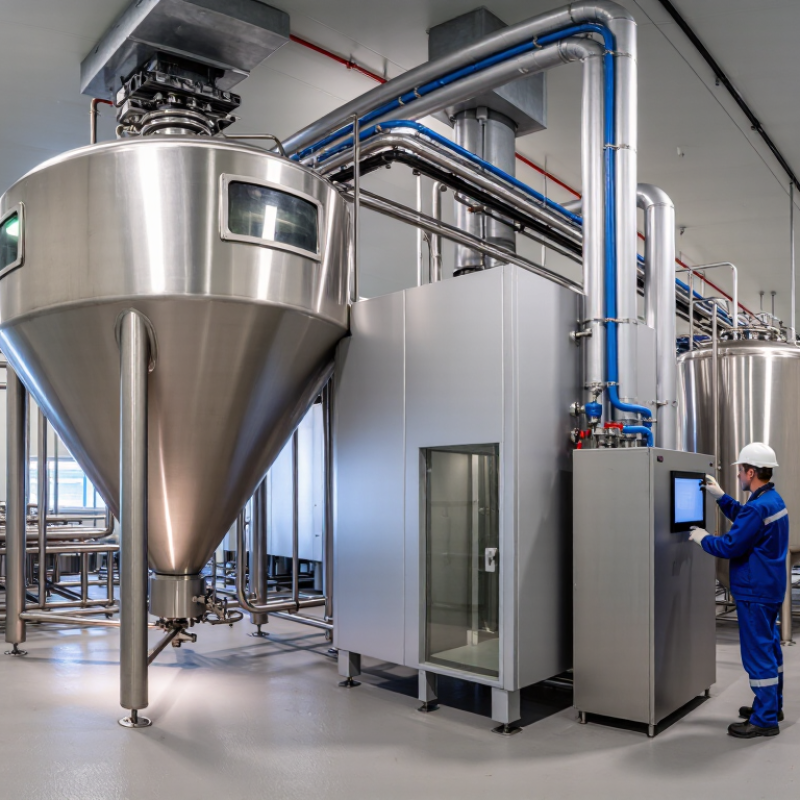
What Is a Commercial Spray Dryer and How Does It Work?
China Best Commercial Spray Dryer Manufacturer?
What Is a Commercial Spray Dryer and How Does It Work?
A commercial spray dryer converts a pumpable liquid into dry powder in a continuous process. It is used for products such as milk ingredients, plant extracts, and food additives. The basic idea is simple. The engineering is not.
A pump sends liquid feed through an atomizer, which breaks it into fine droplets inside a drying chamber. Heated air contacts the droplets, and moisture evaporates within seconds. The dried particles fall toward the chamber base or pass into a cyclone separator and filters for collection. Air temperature, droplet size, and feed rate all affect powder moisture and texture. A small change can matter.
Grand View Research’s Spray Drying Equipment Market report estimated the global market at about US$5.41 billion in 2023 and projected a 6.3% compound annual growth rate through 2030. This market figure covers equipment, not the number of commercial dryers sold. Actual capacity and energy use vary with the material and operating conditions. Buyers should test their own feed: a powder that looks uniform may still absorb moisture quickly or clog during packing.
How Are Commercial Spray Dryer Manufacturers Evaluated?
Commercial spray dryer manufacturers should be judged by repeatable product results, not chamber size alone. Ask for a trial using your actual feed, since a milk-based slurry and a sticky fruit concentrate behave differently. Compare inlet and outlet temperatures, feed rate, final moisture, powder recovery, and wall deposits. Record the method and batch conditions. Details matter.
Particle size is another useful check. Masters’ Spray Drying Handbook describes spray-dried powders in a broad range, commonly around 10–100 μm, depending on feed and atomizer conditions. Treat that as a reference, not a guarantee. Request measured particle-size results alongside moisture and bulk density. A short production run can also reveal whether powder collects cleanly or clings to chamber walls. The U.S. FDA’s 21 CFR Part 117 emphasizes preventive controls in food production, so ask how equipment design supports cleanability and process monitoring. Capacity figures look persuasive. They can still hide inconsistent powder quality. Evaluate service access, spare-part lead times, and operator training, too; these are easy to overlook during a showroom visit.
How to Evaluate a Commercial Spray Dryer Manufacturer
Typical spray-drying temperature ranges provide a starting point for comparing process capability—not a manufacturer ranking.
How to use this chart: Inlet and outlet temperatures depend on the feed, product, and process requirements. Ask manufacturers to validate suitable operating conditions with trials, and compare documented product quality, capacity, energy use, cleaning provisions, and emissions controls.
What Types of Spray Dryers Do Chinese Manufacturers Offer?
What Types of Spray Dryers Do Chinese Manufacturers Offer?
Chinese manufacturers typically offer pressure-nozzle, rotary-atomizer, and two-fluid-nozzle spray dryers. Pressure nozzles suit steady, larger-volume production; rotary atomizers handle varied feed rates and can produce a broad particle-size range. Two-fluid nozzles are often selected for smaller batches or pilot trials. Each design changes droplet formation, so powder texture and moisture need practical testing.
Some suppliers also configure multi-stage dryers with integrated fluid beds, helping powders cool or dry further inside the same production line. Closed-loop systems recirculate drying gas and may suit heat-sensitive or oxygen-sensitive materials. FAO’s Dairy Market Review 2024 estimated global milk production at about 965 million tonnes in 2023. That figure is useful context for dairy processing demand, not a measure of dryer sales. A specification sheet alone cannot predict performance; sticky feeds can behave differently after commissioning.
Tips: Ask for trials using your actual feed. Check inlet and outlet temperatures, target moisture, particle size, cleaning access, and energy use. Request results at your planned capacity, not only a small laboratory scale. Small details matter.
Which Factors Distinguish Leading Chinese Spray Dryer Manufacturers?
Choosing a leading Chinese commercial spray dryer takes more than comparing quoted prices or advertised output. The key question is whether its design matches the material, target moisture, and production rhythm. Ask for test data using a representative feed, not a convenient substitute. Useful records include inlet and outlet temperatures, feed rate, powder moisture, and collection yield. Small details matter. A stable feed pump and sealed duct joints can help prevent uneven drying and product loss. Request drawings, material-contact specifications, and a clear explanation of cleaning access. These details show how well engineering carries through to the factory floor.
Technical support is another separator. Clarify commissioning, operator training, spare-part lead times, and remote fault diagnosis. Ask to speak with users handling comparable products, while respecting confidentiality. A credible manufacturer should explain limits, including heat-sensitive or sticky feeds, instead of promising one setting solves every problem. Check whether quoted capacity reflects actual moisture removal and powder recovery. Numbers can look neat on paper. I would also examine acceptance-test criteria before signing; this step is easy to overlook. No checklist catches everything, so record assumptions and unresolved questions in writing. A factory visit may reveal more than a polished brochure, especially around assembly quality and service response.
How Can Buyers Select a Manufacturer for Their Production Needs?
Selecting a commercial spray dryer begins with the material, not the machine brochure. Document feed composition, solids content, heat sensitivity, target moisture, and daily output. These details shape dryer capacity, atomizer choice, and inlet and outlet temperatures. Ask manufacturers to run representative samples, then review powder moisture, particle size, wall deposits, and recovery data. A glossy sample alone proves little. Request the operating conditions behind it.
Check how the proposed system fits your production floor. Confirm available height, utilities, exhaust treatment, cleaning access, and the space needed for maintenance. Ask for a clear scope covering controls, installation, commissioning, operator training, and spare parts. Speak with users running similar materials and production volumes, if possible. Test the response, too: practical answers should address your feed and constraints, not just list features. Details matter. Compare energy use and expected yield using the same assumptions across bids. No checklist catches every problem; even a careful trial may not reflect months of changing feed quality. Leave room for adjustment, and make sure the supplier explains what can be tuned after startup.