7 Best Ultrapure Water Equipment Suppliers Worldwide?
Choosing among the 7 Best Ultrapure Water Equipment Suppliers Worldwide requires more than comparing glossy brochures. Laboratories, hospitals, semiconductor plants, and pharmaceutical facilities need stable water quality, dependable uptime, and clear technical support. A system producing 18.2 MΩ·cm water may still disappoint if its total organic carbon rises or maintenance becomes difficult.
Water-quality authority Dr. Rita Colwell has said, “Water is the most important natural resource on Earth.” Her words remain relevant here. Ultrapure water is not simply a product leaving a polishing unit. It depends on pretreatment, reverse osmosis, deionization, membrane performance, monitoring, sanitization, and trained operators. Small details matter. A poorly placed sensor can create misleading confidence.
This guide examines seven global suppliers through practical criteria. These include purification performance, system customization, validation documents, consumable availability, service response, energy use, and lifecycle cost. Certifications help, but they do not tell the whole story. Site conditions can change everything.
No supplier is perfect. That deserves honest attention. One company may offer excellent instruments but weak regional support. Another may provide robust engineering at a higher operating cost. Buyers should inspect real references, not only impressive specifications. Ask who responds when resistivity drops at 2 a.m. Also ask how quickly replacement filters arrive.
The shortlist is useful, but it is not final truth. Application requirements, local water chemistry, compliance expectations, and budget must shape the decision. A careful comparison can prevent expensive surprises and protect critical laboratory results.
What Is Ultrapure Water Equipment?
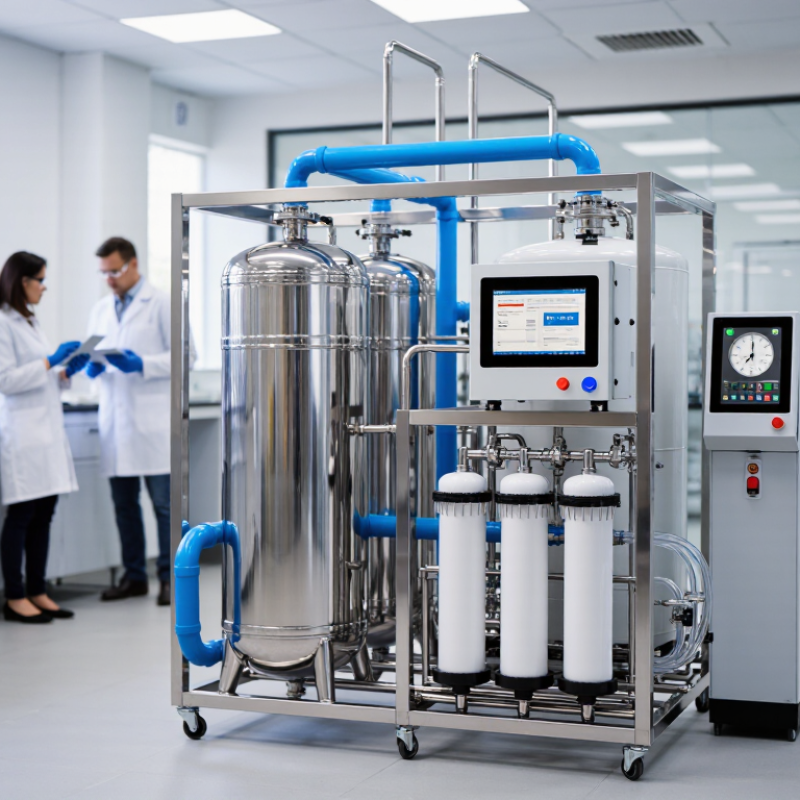
Ultrapure water equipment is a connected treatment system, not simply an advanced filter. It removes ions, particles, organic carbon, microbes, and dissolved gases from incoming water. Typical systems combine pretreatment, reverse osmosis, deionization, ultraviolet oxidation, ultrafiltration, and final polishing. The target is often 18.2 megohm-centimeters at 25°C, with very low organic carbon and microbial content. ASTM D1193 and ASTM D5127 describe quality expectations for laboratory and semiconductor applications.
The equipment also includes storage tanks, circulation loops, sensors, and hygienic piping. These parts matter because purified water can quickly collect particles from dead legs, seals, or poorly maintained tanks. USP <1231> emphasizes continuous control, sampling, and validated sanitization for pharmaceutical water systems. A 2024 semiconductor industry report from the Semiconductor Industry Association notes that chip manufacturing depends heavily on reliable water infrastructure, especially during high-volume production. However, “ultrapure” is not a universal performance label. Requirements differ by laboratory, wafer process, or pharmaceutical use. No system stays perfect without monitoring.
In practice, operators track resistivity, total organic carbon, temperature, pressure, flow, and microbial results. Small changes can reveal exhausted resin or membrane fouling. Specifications should therefore include recovery rate, reject-water management, maintenance intervals, and alarm accuracy. A cheaper unit may become expensive when consumables and downtime are counted.
How to Evaluate Global Ultrapure Water Suppliers
Choosing among the 7 best ultrapure water equipment suppliers worldwide requires more than comparing quoted prices. Experienced buyers inspect the complete treatment process, from pretreatment and reverse osmosis to polishing and final filtration. Ask for verified product data, not attractive promises. A reliable supplier should provide conductivity, resistivity, total organic carbon, and microbial-control results under defined operating conditions.
Supplier evaluation should include factory audits, documented quality systems, and reference installations with similar feedwater. Request a commissioning plan that identifies sampling points, calibration methods, and response times for alarms. On-site details matter. Can technicians reach the facility quickly? Are replacement membranes and sensors available locally? A low purchase price becomes expensive when one failed pump stops laboratory production for two days.
Read the service agreement carefully. It should explain preventive maintenance, operator training, software updates, spare-part costs, and performance guarantees. Independent validation records can reveal weaknesses that brochures hide. Still, no supplier is perfect. A technically strong system may have slow regional support, while a smaller provider may offer better communication but limited documentation. Compare lifecycle cost over five to ten years, including water use, energy demand, consumables, and disposal requirements. Keep an audit trail for every decision. It supports accountability and exposes assumptions that may deserve another review.
Seven Leading Ultrapure Water Equipment Suppliers Worldwide
Seven Leading Ultrapure Water Equipment Suppliers Worldwide
The worldwide ultrapure water market is expanding with laboratory, pharmaceutical, and semiconductor demand. Grand View Research forecasts strong single-digit annual growth through 2030. MarketsandMarkets also identifies Asia-Pacific as a major growth region, driven by chip fabrication and stricter water controls. These figures suggest opportunity, but they do not guarantee supplier quality.
A practical global shortlist covers seven supplier profiles: turnkey treatment integrators, membrane specialists, ion-exchange experts, ultraviolet and TOC-control manufacturers, point-of-use laboratory system providers, semiconductor-grade system builders, and validation-service partners. The strongest candidates should demonstrate ASTM D1193 or ISO 3696 compliance. Type 1 water typically reaches 18.2 megohm-centimeter resistivity at 25°C, with TOC commonly below 5 parts per billion. Small deviations matter.
Supplier evaluation should include factory testing, installation records, calibration certificates, and response times for replacement cartridges. Experienced users also inspect loop design, dead legs, sanitization access, and real-time conductivity monitoring. A polished brochure is not enough. Some systems perform well during commissioning but drift under heavy daily use. That weakness deserves attention. Regional technicians, documented preventive maintenance, and verified consumable availability can reduce downtime. Buyers should compare total ownership cost, not only the initial equipment quotation.
Ultrapure Water Equipment: Typical Resistivity Gain Across Treatment Stages
Ultrapure water is commonly produced through multiple purification stages. This chart shows representative resistivity benchmarks, measured at 25°C, as water moves from incoming supply through reverse osmosis, electrodeionization, and final polishing.
A resistivity of 18.2 MΩ·cm is the commonly recognized theoretical maximum for Type I ultrapure water at 25°C. Actual performance varies with feed-water quality, system design, maintenance, temperature, and operating conditions.
Key Technologies Offered by Ultrapure Water Manufacturers
Selecting among the 7 best ultrapure water equipment suppliers worldwide requires more than comparing flow rates. The critical question is whether each manufacturer combines reliable purification stages with measurable control. A typical system uses multimedia filtration, activated carbon, softening, reverse osmosis, electrodeionization, ultraviolet treatment, ultrafiltration, and final polishing. Each stage removes a different threat.
Reverse osmosis often provides the main ionic and organic reduction, while electrodeionization maintains low conductivity without routine chemical regeneration. UV systems can reduce microorganisms and total organic carbon, but lamp intensity must be monitored continuously.
Ultrafiltration helps control endotoxins and particles near the point of use. ASTM D5127 and USP guidance support testing parameters such as resistivity, conductivity, TOC, microbial levels, and endotoxins. Small sensors matter.
Market evidence supports this technical focus. Grand View Research estimated the global ultrapure water market at approximately USD 7.3 billion in 2023, with continued growth expected through 2030. MarketsandMarkets also identified semiconductor, pharmaceutical, and laboratory demand as major growth drivers. These sectors require traceable data, validated cleaning procedures, and stable water quality, not attractive brochures.
In practice, remote monitoring, automatic alarms, sanitary piping, and documented maintenance often separate dependable equipment from merely functional equipment. Some installations still over-specify polishing capacity. That raises energy use and replacement costs unnecessarily. Careful engineers should challenge the design, review local feed-water chemistry, and verify performance through independent testing before approval.
How to Choose the Right Supplier for Your Facility
Choosing the right ultrapure water equipment supplier requires more than comparing seven websites. Start with your facility’s actual water profile, daily demand, peak flow, and required resistivity. A laboratory may need stable polishing, while a production site may require continuous circulation and heat sanitization. Ask suppliers for process diagrams, material certificates, validation records, and recent installation references. Vague answers deserve caution.
Technical support matters after delivery. Check whether engineers can review feed-water analysis, installation drawings, and sampling points before equipment arrives. Confirm response times, spare-parts availability, operator training, and remote monitoring options. A reliable supplier should explain maintenance intervals in practical terms, not hide them inside complex contracts. Request a factory acceptance test and clear performance criteria. Small details often prevent expensive downtime.
Price still matters, but lifecycle cost matters more. Compare energy use, consumables, membrane replacement, sanitization time, and wastewater volume. Visit a working facility if possible. Watch how operators collect samples and respond to alarms. No scorecard is perfect. My own preference would be to weight service evidence more heavily than polished presentations. A supplier can offer excellent equipment yet struggle with documentation or local support. Leave room for that uncomfortable question: will the system remain dependable five years after installation?